
Whether you're eyeing a jet ski at the marina or considering something more compact like an electric jet boat, understanding what is a personal watercraft matters before you hit the water. The term carries specific legal weight, it determines which registration rules apply, what safety gear you need, and where you're actually allowed to ride.
A personal watercraft (PWC) isn't just marketing language. It's a regulated vessel category with definitions that vary by state and country, affecting everything from age restrictions to required boater education. If you're researching for compliance, insurance, or simply to know what you're buying, this guide breaks down the official criteria.
At Wave-Vo, we build electric jet boats that fit within the PWC category while eliminating the traditional hassles of gas engines and trailer towing. Below, you'll find the complete definition of a personal watercraft, the rules governing their use, and the features that set different types apart, including how newer electric options are changing the category entirely.
Why personal watercraft classification matters
Understanding what is a personal watercraft from a regulatory standpoint directly affects your wallet, your access to waterways, and your legal exposure. The classification triggers specific state and federal requirements that differ from standard boats, even when both vessels share similar sizes or speeds. If you buy or operate a craft without knowing its category, you risk fines, rejected insurance claims, or outright prohibition from certain waters.
Registration and insurance implications
Your PWC classification determines which registration process you follow and how much you pay. Most states treat PWCs separately from traditional boats, requiring distinct decals, hull identification numbers, and annual renewal fees. In Florida, for example, PWCs carry a flat registration fee regardless of length, while boats face tiered pricing based on footage. This distinction saves or costs you money depending on which category your craft falls under.
Insurance companies price PWC policies differently than boat coverage because actuarial data shows higher accident rates for jet-propelled vessels. You'll typically pay 15 to 30 percent more for PWC insurance compared to a similarly valued fishing boat. Some carriers refuse PWC coverage entirely or impose age and experience restrictions on operators. If your electric jet boat legally qualifies as a PWC, expect underwriters to treat it as one, even if it lacks the traditional sit-on design.
Classification errors can void your insurance policy entirely if an adjuster determines you misrepresented your vessel type during the application process.
Where you can (and can't) operate
Many lakes, rivers, and coastal zones impose PWC-specific restrictions that don't apply to other small boats. You'll encounter no-wake zones, outright bans during certain hours, and designated PWC-only areas that standard boats can't enter. Lake Tahoe, for instance, prohibits PWCs between 7 PM and 10 AM year-round, while allowing other motorized vessels during those hours. The classification labels your craft for enforcement purposes, not the physical characteristics you see.
State park waters often ban PWCs completely while permitting electric trolling motors and outboard boats. If your watercraft meets the legal definition of a PWC, you face these restrictions regardless of how quietly it operates or how small its wake measures. Electric propulsion doesn't exempt you from PWC rules unless your state explicitly carves out exceptions for battery-powered craft.
Age limits and education requirements
PWC operators face stricter age minimums than boat captains in 48 of 50 states. California requires PWC operators to be at least 16 years old, while allowing 12-year-olds to operate standard motorboats with proper supervision. These age thresholds exist because regulators classify PWCs as higher-risk vessels requiring greater maturity and judgment.
Boater education mandates also escalate for PWC users. States like Texas require all PWC operators born after September 1, 1993 to complete a safety course, while exempting many traditional boat operators from the same requirement. Your craft's classification determines whether you need to invest time and money in certification before your first launch.
What makes a craft a PWC
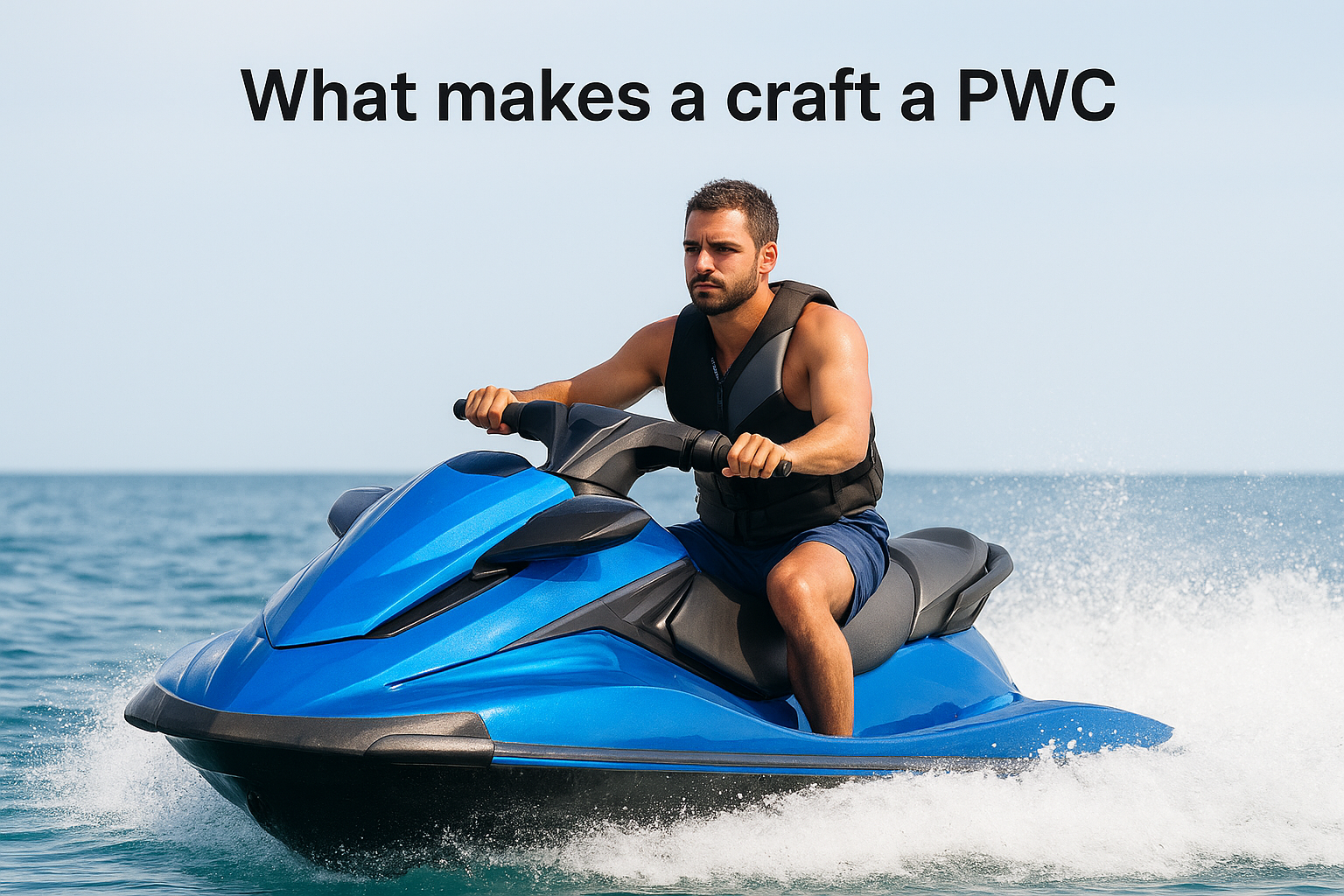
The United States Coast Guard establishes the baseline definition that determines what is a personal watercraft across federal waters. A craft qualifies as a PWC when it meets three specific criteria that separate it from conventional boats, regardless of propulsion type, hull material, or manufacturer claims. You need to understand these technical thresholds because state agencies build their regulations on top of the federal foundation.
Federal definition and size parameters
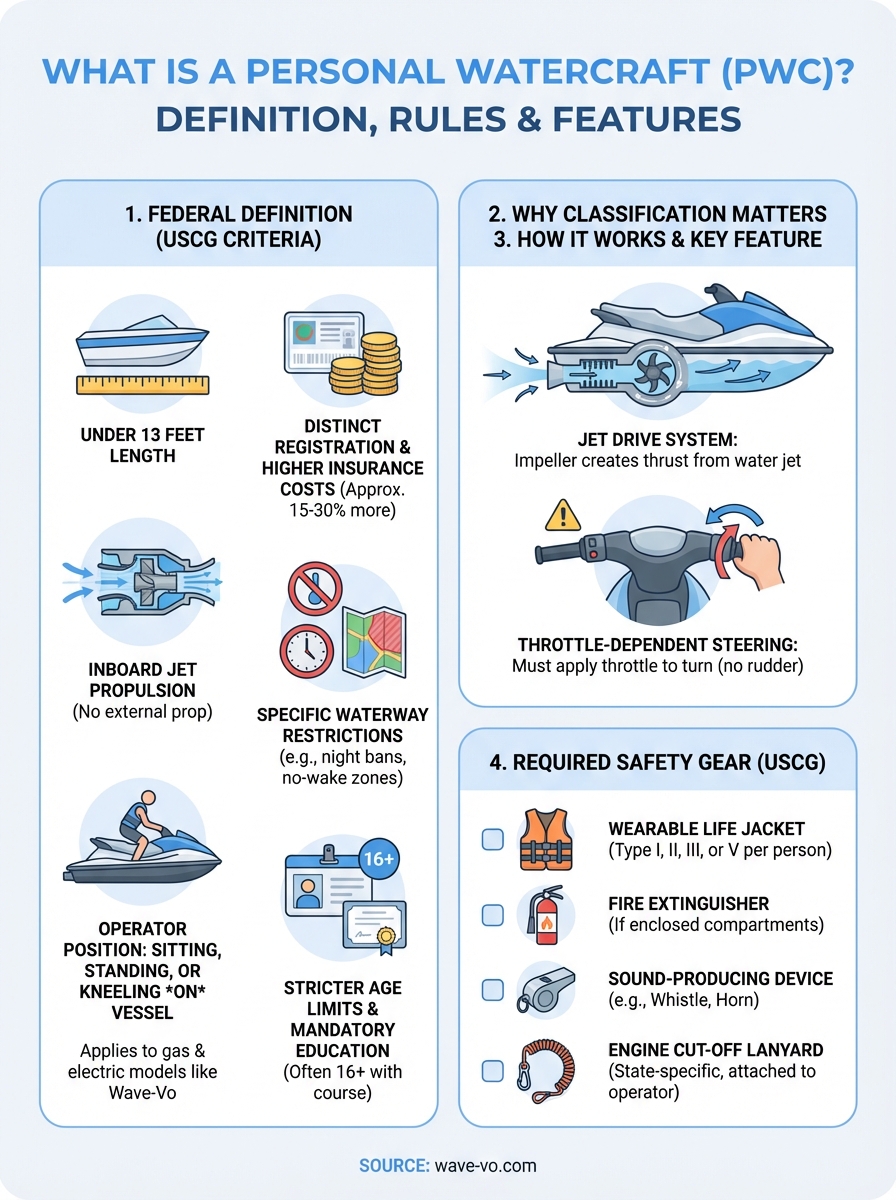
According to 33 CFR 173.3, a personal watercraft must measure less than 13 feet in length as the primary size restriction. Your craft automatically exits PWC classification if it exceeds this footage, even when it uses jet propulsion and allows standing operation. The measurement follows standard boat length rules, running from the tip of the bow to the stern's farthest point, excluding motors, swim platforms, or other attachments.
Beyond length, the vessel must use inboard propulsion with a water jet pump as the primary source of thrust. This requirement eliminates outboard motors and propeller-driven craft from the category. Electric jet boats like those from Wave-Vo meet this criterion through their internal electric motors and jet drive systems, which operate on the same propulsion principle as gas-powered PWCs.
If your watercraft features a traditional propeller or exceeds 13 feet, federal law excludes it from PWC classification regardless of its other characteristics.
The operator position requirement
You'll find the distinguishing feature of PWCs in how you operate them. The regulations require that the craft be designed for operation by a person sitting, standing, or kneeling on the vessel rather than sitting inside a traditional cockpit or cabin. This position standard separates jet boats with enclosed seating from true PWCs, even when both use identical propulsion technology.
Manufacturers can't bypass this requirement through design tricks. If your vessel has a conventional boat-style seat where you sit inside or below the gunwales, it fails the operator position test. The rule focuses on your body's relationship to the hull during normal operation, not whether you could theoretically stand up while driving.
How PWCs work: jet drive and control basics
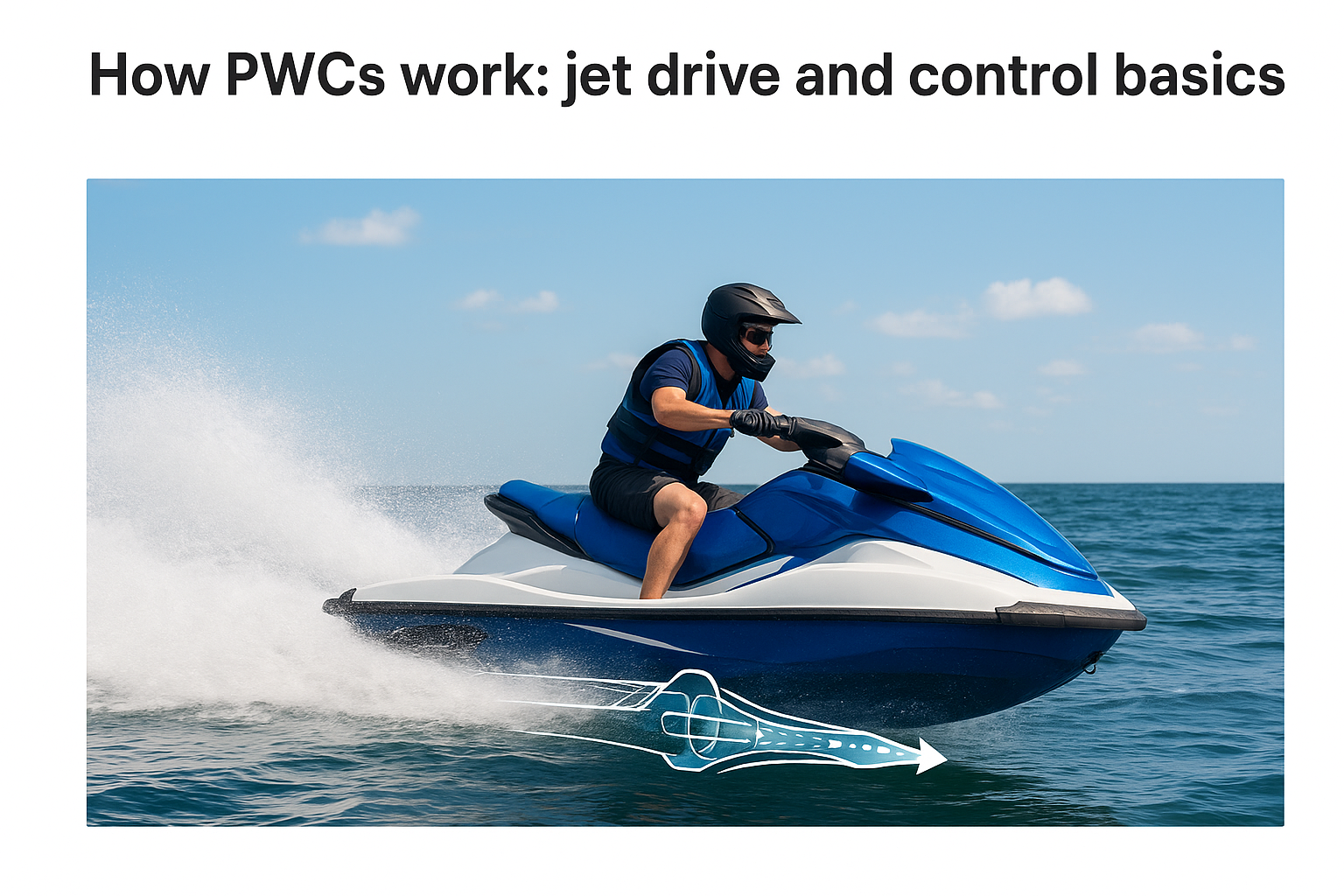
Understanding what is a personal watercraft requires knowing how these vessels move and turn differently from propeller-driven boats. PWCs use jet propulsion technology that pulls water through an intake grate, pressurizes it inside a pump housing, and forces it out through a nozzle at high velocity. This thrust-based system eliminates external propellers entirely, creating the characteristic rooster tail spray and allowing PWCs to operate in shallow water as shallow as 12 inches.
The jet propulsion system
Your PWC's engine or motor drives an impeller inside a sealed pump housing mounted in the hull's bottom. Water enters through a grate that protects the impeller from debris and large objects. The spinning impeller acts like a centrifugal fan, accelerating water molecules and forcing them through a narrowing discharge nozzle that increases pressure and velocity. The expelled water jet creates forward thrust following Newton's third law of motion.
Electric PWCs like Wave-Vo's jet boats replace combustion engines with brushless electric motors that spin the impeller directly or through a reduction drive. The propulsion principle remains identical whether your power source burns fuel or draws from a battery pack. You'll notice instant torque delivery with electric systems because motors reach full power immediately, unlike gas engines that need RPM buildup.
The absence of external propellers makes jet-driven craft safer around swimmers and in congested areas, though the powerful water stream itself poses risks near the stern.
Steering without a rudder
PWCs steer by redirecting the water jet rather than using a rudder like traditional boats. When you turn the handlebars or wheel, you pivot a movable nozzle that changes the thrust direction. The hull follows the redirected water jet, allowing tight turning radiuses impossible with rudder-steered vessels. This system requires forward thrust to function, your PWC loses steering authority when you release the throttle or kill the engine.
Understanding this throttle-dependent steering prevents accidents. You must maintain some throttle input during turns to keep directional control. Letting off the gas in a panic often causes riders to continue straight into obstacles they're trying to avoid, since the steering system stops working without water flow through the jet nozzle.
US rules and required safety gear
Federal and state regulations impose specific equipment mandates on PWC operators that exceed standard boat requirements. You'll face penalties ranging from $100 fines to criminal charges if you operate without the proper safety gear, regardless of how short your ride or how calm the conditions appear. Understanding what is a personal watercraft from a legal compliance perspective means knowing which items you must carry before leaving the dock.
Federal Coast Guard requirements
The United States Coast Guard requires every PWC to carry a wearable Type I, II, III, or V life jacket for each person aboard, regardless of age or swimming ability. You can't substitute throwable cushions or ring buoys that work for traditional boats. The life jacket must fit properly and remain accessible, not buried in storage compartments where you can't reach it during an emergency.
Your PWC needs a fire extinguisher if it has enclosed engine or fuel compartments, which applies to most gas-powered models but exempts many electric jet boats with sealed battery systems. You must also carry a sound-producing device like a whistle or air horn capable of producing a four-second blast audible for half a mile. Registration numbers and validation decals must appear on both sides of the bow in block letters at least three inches high.
States can add equipment requirements beyond federal minimums, but they cannot remove or reduce Coast Guard mandates.
State variations you need to know
Different states layer additional safety gear requirements onto the federal baseline. California mandates a paddle or oar on all PWCs as emergency propulsion, while Florida requires an engine cutoff lanyard that attaches to your wrist or life jacket. You'll need to research your specific state's rules before operating, as ignorance doesn't protect you from citations.
Age and education mandates
Most states restrict PWC operation to riders aged 14 to 16 and older, with younger operators requiring direct adult supervision. You'll also need to complete a boater safety course in 43 states, with certification cards you must carry while operating. These education requirements target PWC operators specifically because accident data shows higher injury rates compared to other vessel types.
PWC vs boats and other watercraft
The distinction between PWCs and other watercraft types goes beyond propulsion systems and enters territory that affects your purchasing decision, operating costs, and legal obligations. While a small fishing boat and a jet ski might both fit in your garage and cost similar amounts, they operate under entirely different regulatory frameworks that create practical differences you'll notice every time you launch. Understanding what is a personal watercraft versus other vessel categories helps you choose the right option for your specific water activities.
Legal and operational differences
Traditional boats face looser age restrictions and often skip mandatory education requirements that PWC operators must complete. You can legally hand a 12-year-old the controls of a 15-foot fishing boat in many states, but that same child cannot operate a PWC until they're several years older. The regulatory burden increases with PWC classification because agencies view them as higher-risk vessels despite comparable speeds and capacities.
Waterways that welcome standard boats routinely ban PWC access entirely, particularly in environmentally sensitive areas or near residential shorelines. Your fishing boat gets access to protected coves and wildlife zones that remain off-limits to jet ski operators, even when both vessels meet emissions standards and noise limits. This access disparity stems from the PWC classification itself, not the vessel's actual environmental impact.
Performance and design contrasts
PWCs deliver instantaneous throttle response and turning radiuses under two meters, capabilities that traditional propeller boats cannot match regardless of horsepower. You'll execute 360-degree spins and acceleration runs impossible in hulls designed for displacement cruising. However, this agility comes with throttle-dependent steering that eliminates control when you release the gas, creating a learning curve that conventional boat operators don't face.
Electric jet boats blur these traditional category lines by combining PWC maneuverability with boat-like stability, though they still face PWC regulations based on hull length and operator position.
Storage and transport separate PWCs from boats most dramatically. You can fit a 75-kilogram electric jet boat inside your SUV's cargo area, while comparable fishing boats require dedicated trailers, tow vehicles, and marina slip fees that add thousands in annual costs.
Next steps
You now understand what is a personal watercraft from federal definitions through practical operation, including the size limits, jet propulsion requirements, and operator position criteria that trigger PWC classification. This knowledge prevents registration mistakes, insurance coverage gaps, and waterway access violations that cost you time and money. Your craft's legal status determines compliance obligations regardless of its brand, propulsion type, or physical appearance, so verify classifications before you buy or register any vessel.
Ready to experience PWC agility without traditional ownership hassles? Explore Wave-Vo's electric jet boats that combine sharp handling with genuine convenience and portability. You'll get the instant acceleration and tight turns that define personal watercraft while eliminating gas station visits, engine maintenance schedules, trailer storage fees, and the hour-long launch routines that make conventional watercraft ownership feel like a second job instead of weekend recreation.