
Whether you just purchased a personal watercraft, fishing boat, or compact electric vessel like a Wave-Vo, completing your Texas Parks and Wildlife boat registration is a required step before you hit the water. Texas law mandates that most motorized boats operating on public waters carry valid registration, and the process involves specific forms, fees, and documentation that can feel overwhelming if you're new to boat ownership.
This guide breaks down everything you need to know about registering, titling, and renewing your boat through the Texas Parks and Wildlife Department. You'll find step-by-step instructions for both online and in-person registration, current fee schedules, required documents, and answers to common questions. By the end, you'll have a clear path from paperwork to legally cruising Texas lakes and waterways, no guesswork involved.
What you need before you start
Gathering your materials before you begin the Texas Parks and Wildlife boat registration process saves time and prevents frustrating delays. You need specific documents, accurate vessel details, and a payment method ready before you submit your application. Missing even one piece of information can force you to restart the entire process or wait for manual review, which adds weeks to your timeline.
Essential documents and information
You must have your vessel's Hull Identification Number (HIN), which appears on the transom of your boat, typically on the starboard (right) side near the top. This 12-character code acts like a VIN for boats and directly ties your registration to the correct watercraft. You also need your proof of ownership, such as a signed bill of sale, manufacturer's certificate of origin, or the previous owner's title if you purchased a used boat.
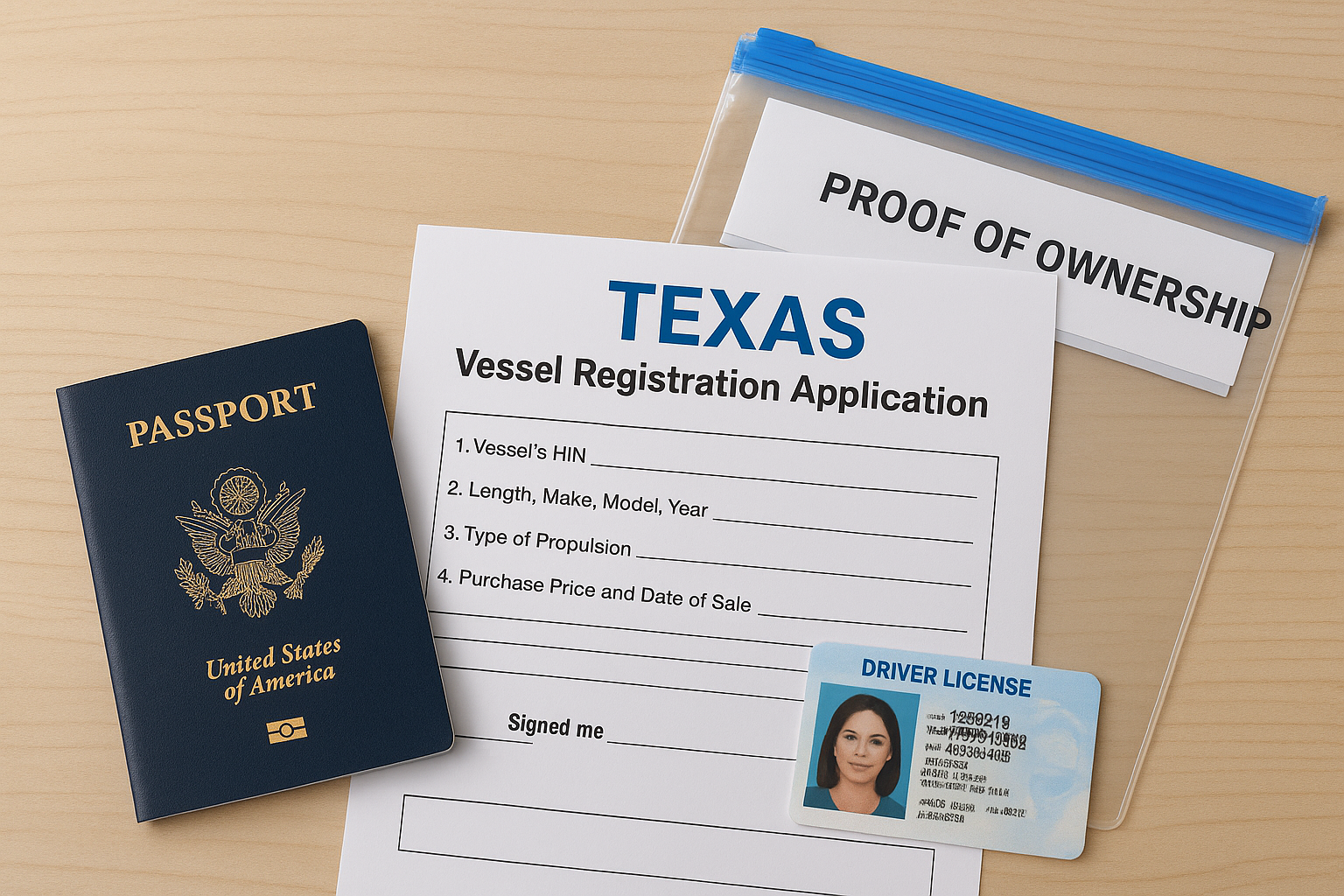
Keep your HIN documentation and purchase proof in a waterproof folder; you'll reference these throughout the ownership lifecycle.
Prepare these additional items before starting your application:
- Valid photo ID (driver's license or state-issued ID)
- Proof of Texas residency (utility bill or lease agreement)
- Length, make, model, and year of your vessel
- Type of propulsion (outboard, inboard, electric motor, sail)
- Purchase price and date of sale
- Lienholder information if you financed your purchase
Payment methods accepted
Texas Parks and Wildlife accepts credit cards, debit cards, and electronic checks for online applications. You can also pay by personal check or money order if you submit your registration through mail or in person at a county tax office. Cash payments are accepted only at physical offices, not through online or mail submissions.
Step 1. Check if your vessel needs registration
Not every boat operating in Texas waters requires Texas Parks and Wildlife boat registration, but most motorized vessels do. You need to determine whether your specific watercraft falls under the registration requirement before you spend time gathering documents or filling out forms. This step takes only a few minutes but saves you from unnecessary paperwork if your vessel qualifies for an exemption.
Vessels that require registration
Your vessel requires registration if it has any type of motor, including electric motors like those on a Wave-Vo, gas outboards, or inboard engines. Texas law applies this requirement to all motorized boats operating on public waters within the state, regardless of where you purchased the vessel. If you can start an engine or motor and propel the boat forward, you must register it.
Any boat with a motor, even a small electric trolling motor, needs official registration numbers displayed on the hull.
Exemptions from registration
You do not need to register vessels that are exclusively powered by paddle, oar, or sail with no auxiliary motor. Boats documented by the U.S. Coast Guard also receive an exemption from state registration, though you still need proof of federal documentation on board. Finally, non-motorized vessels like canoes, kayaks, and stand-up paddleboards never require Texas Parks and Wildlife registration.
Step 2. Gather details, forms, and proof
You need to complete the correct PWD 143 Application for Texas Certificate of Number for Numbered Vessel form and compile supporting documents before submitting your texas parks and wildlife boat registration. The form itself requests specific information about your vessel, your identity, and your purchase, and you must answer every required field accurately to avoid processing delays. Download the form directly from the Texas Parks and Wildlife website or pick up a physical copy at any county tax office that handles boat registrations.
Required forms and information
The PWD 143 form requires you to enter your vessel's HIN, length in feet, propulsion type, hull material, and primary use (recreational, commercial, or livery). You also provide your full legal name, physical address, mailing address if different, and contact details. If you financed your boat, you must include the lienholder's name and address in the designated section, as this information appears on your title and registration certificate.
Bill of sale template
Your bill of sale must include the seller's signature, buyer's signature, purchase price, date of sale, and vessel description. Texas does not provide an official bill of sale form, so you can create your own document as long as it contains these elements. Use this template structure:
BILL OF SALE

Seller Name: [Full Name]
Buyer Name: [Full Name]
Date of Sale: [MM/DD/YYYY]
Purchase Price: $[Amount]

Vessel Description:
Make: [Brand]
Model: [Model Name]
Year: [Year]
HIN: [12-Character HIN]

Seller Signature: _________________ Date: _______
Buyer Signature: _________________ Date: _______
Always keep the original bill of sale in your boat documents; copies may not satisfy law enforcement during inspections.
Step 3. Choose online, mail, or office filing
Texas gives you three distinct options for submitting your texas parks and wildlife boat registration application, and each method has specific advantages depending on your timeline and preferences. You can complete the entire process digitally through the official TPWD website, mail physical documents to the state office, or visit a county tax assessor-collector office in person. Your choice affects processing speed, convenience, and whether you receive instant confirmation or wait for physical documents to arrive.
Online registration through TPWD
The online system at tpwd.texas.gov processes most applications within 24 to 48 hours and lets you upload scanned documents directly through the portal. You create an account, enter your vessel details, attach digital copies of your bill of sale and proof of identity, and pay immediately with a credit card or electronic check. This method gives you the fastest turnaround time and eliminates postage costs or travel to an office.
Online filing delivers your registration certificate digitally, letting you print temporary proof while the permanent decals ship to your address.
Mail and office alternatives
You send completed PWD 143 forms, original bills of sale, and payment to Texas Parks and Wildlife Department, 4200 Smith School Road, Austin, TX 78744 if you choose mail submission. Processing takes two to four weeks from the date they receive your envelope. Alternatively, you walk into any participating county tax office with your documents and receive same-day service during business hours.
Step 4. Pay fees and place your numbers
Your texas parks and wildlife boat registration costs depend on the length of your vessel, and you must display your assigned registration numbers correctly on both sides of the bow within 30 days of receiving your certificate. The fee structure remains fixed for two-year registration periods, and you pay the full amount upfront regardless of when you purchase your boat during the year. Texas does not prorate registration fees based on purchase date or time remaining in the current registration cycle.
Current registration fees
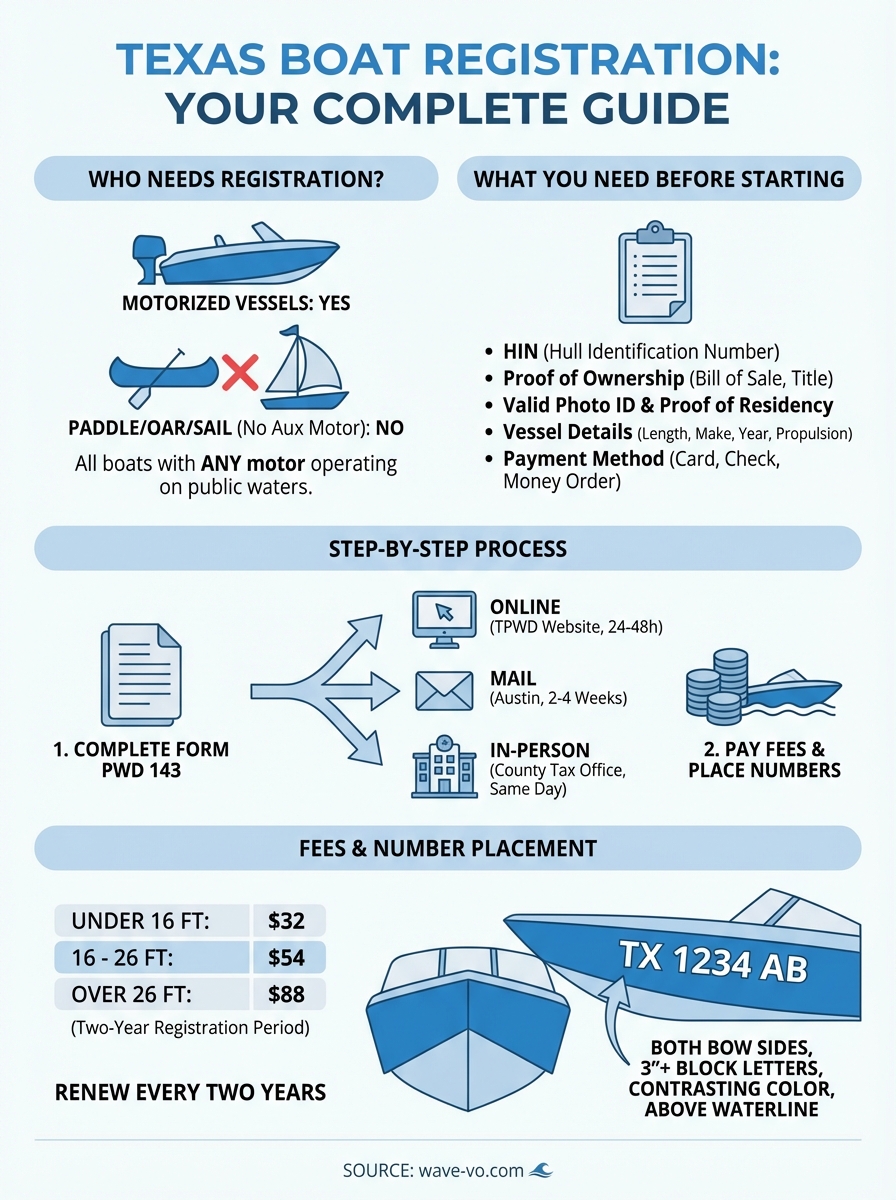
You pay $32 for boats under 16 feet in length, which covers most personal electric watercraft like the Wave-Vo and small fishing boats. Vessels between 16 and 26 feet cost $54, while boats over 26 feet require $88 for the two-year registration period. Add $2 to your total if you need to transfer an existing registration from another owner.
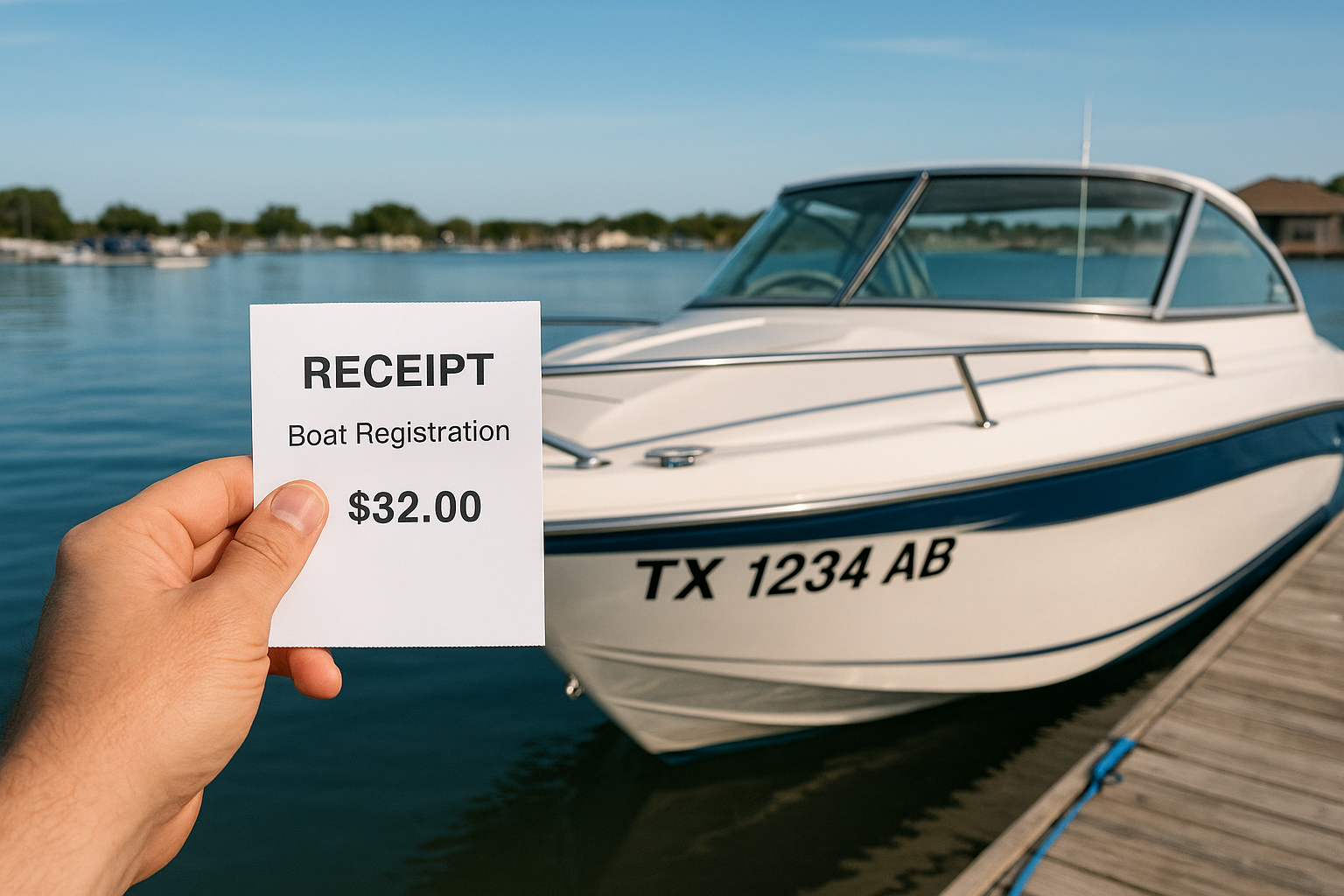
Keep your receipt as proof of payment until your permanent registration certificate arrives in the mail.
Number placement requirements
You affix your registration numbers on both sides of the forward half of the vessel, reading from left to right when facing the bow. The numbers must be at least 3 inches tall, in block characters, and contrast sharply with your hull color (use black numbers on light hulls, white on dark hulls). Place them higher than the waterline and leave space between the letters and numbers: TX 1234 AB, not TX1234AB.
You are ready to boat legally in Texas
You now have a complete roadmap for completing your texas parks and wildlife boat registration from start to finish. Your vessel meets all legal requirements once you display your registration numbers correctly, carry your certificate on board, and renew every two years before expiration. Texas law enforcement officers can stop you on any public waterway to verify your registration status, so keeping your documents accessible prevents citations and ensures smooth lake outings.
Registration applies equally to traditional gas boats and modern electric watercraft. If you're considering an electric personal watercraft that eliminates fuel costs, maintenance headaches, and trailer requirements, check out the Wave-Vo electric jet boat. The compact design fits in your SUV or truck bed, the 10-second battery swap extends your ride time indefinitely, and the 15kW motor qualifies for standard motorized vessel registration. You complete the same PWD 143 form with the same fees, but you skip gas dock visits and engine winterization forever.