
If you're still paying the same interest rate you locked in when you first bought your boat, you're likely spending more than you need to. Choosing to refinance my boat loan is one of the simplest ways to reduce monthly payments, shorten your loan term, or free up cash for upgrades, like adding a Wave-Vo electric jet boat to your dock lineup.
Refinancing a boat loan works a lot like refinancing a car or a home. You replace your current loan with a new one that has better terms, whether that means a lower interest rate, a different repayment schedule, or both. But the process has a few quirks specific to marine lending that are worth understanding before you apply. Rates vary based on your boat's age, your credit score, and how much you still owe relative to the vessel's current value.
This guide walks you through every step, from checking your eligibility and comparing lenders to calculating your actual savings before you commit. We've also included a breakdown of current refinancing rates so you can see exactly where you stand and make a decision based on real numbers, not guesswork.
When refinancing makes sense
Refinancing isn't the right move for everyone at every point in a loan. The decision comes down to whether the new terms produce a real financial benefit that outweighs the cost and effort of switching lenders. Before you decide to refinance my boat loan, it helps to know the specific conditions that tend to generate savings versus the situations where refinancing just reshuffles numbers without meaningfully improving your position.
Signs your current loan is costing you too much
The clearest signal that refinancing makes sense is a significant gap between your current interest rate and what lenders are offering today. If you took out your boat loan two or more years ago and rates have dropped by 1.5 percentage points or more since then, you likely have real savings available. For example, on a $30,000 loan with 60 months remaining, dropping your rate from 9.5% to 7.0% saves you roughly $2,200 in total interest over the life of the loan.
A rate difference of even 1 percentage point can translate to hundreds of dollars saved per year on a mid-size boat loan.
Other signs worth taking seriously include:
- Your monthly payment is straining your budget, even though your income has stayed the same or grown
- Your original loan came with a short repayment term you now need to extend to improve monthly cash flow
- You financed through a dealership and suspect the rate was marked up above what direct lenders would have offered
- Your credit score has climbed by 50 or more points since you first signed the loan documents
- You have a variable-rate loan and want to lock in a fixed rate before rates move higher
Each of these situations gives a new lender a reason to offer you materially better terms, and gives you a clear financial case for making the switch.
When it's better to wait
Refinancing also comes with real costs, and timing matters. If your loan is nearly paid off, say within 12 to 18 months of the final payment, the interest savings from a lower rate will likely be small enough that closing costs, origination fees, or title transfer charges cancel them out entirely. In that case, you would spend time and effort for minimal gain.
You should also hold off if your credit profile has weakened recently, whether from a missed payment, a spike in credit utilization, or a cluster of new hard inquiries. Applying under those conditions risks getting a rate equal to or worse than what you already carry. Give your credit three to six months to recover, then apply when you can negotiate from a position of strength.
Step 1. Gather loan details and set a target
Before you contact a single lender, pull together everything related to your current loan in one place. Starting with complete, accurate information speeds up the process and prevents you from accepting terms that look better on the surface but fail to deliver real savings once fees are added back in.
What loan details you need
You need six specific pieces of information to move forward when you refinance my boat loan: your current lender's name, your outstanding balance, your current interest rate, your remaining loan term in months, your monthly payment amount, and any prepayment penalty stated in your original loan agreement. You can find most of this on your most recent loan statement or by logging into your lender's online portal.
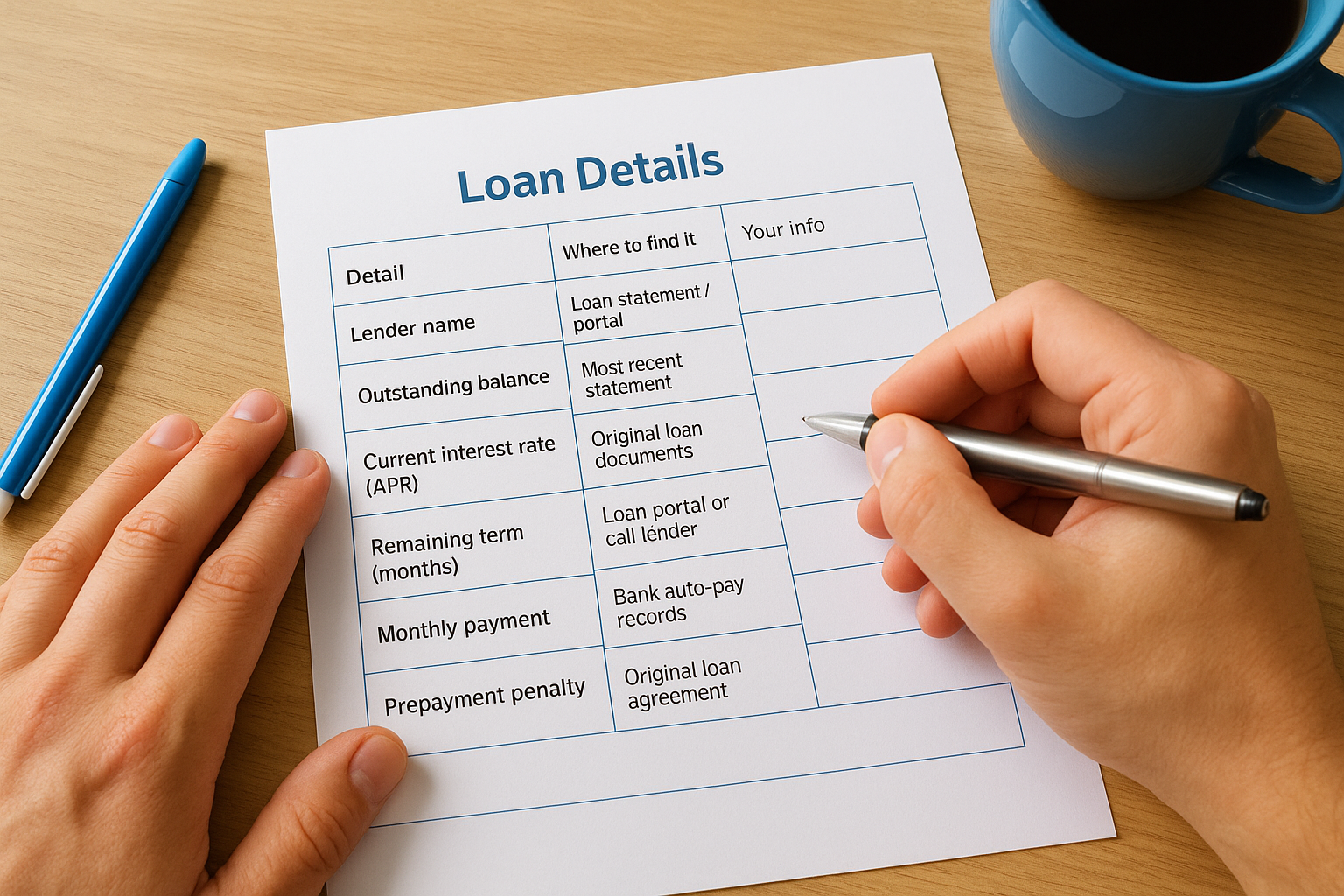
Collect them in one place using this template:
| Detail | Where to find it | Your info |
|---|---|---|
| Lender name | Loan statement / portal | |
| Outstanding balance | Most recent statement | |
| Current interest rate (APR) | Original loan documents | |
| Remaining term (months) | Loan portal or call lender | |
| Monthly payment | Bank auto-pay records | |
| Prepayment penalty | Original loan agreement |
If your original loan documents are missing, call your lender directly and ask for a payoff quote, which will confirm your balance, rate, and any penalty tied to early repayment.
Set a savings target before you apply
Once you have your numbers, define the minimum improvement that makes refinancing worth your time. A practical rule of thumb is to target at least a 1 percentage point drop in your APR or a reduction of $50 or more per month. Write that number down before you start comparing lenders so you have a clear threshold to measure offers against rather than reacting emotionally to the first rate that looks attractive.
Step 2. Check credit, equity, and boat value
A lender evaluating your refinance application looks at three things before quoting a rate: your creditworthiness, how much equity you hold in the boat, and what the vessel is worth today. Running these checks yourself before you apply gives you an accurate picture of the rate you can realistically expect and helps you catch any problems that could hurt your application.
Check your credit score
Your credit score is the single biggest factor in the rate a lender will offer when you refinance my boat loan. Most marine lenders use FICO scores, and the difference between a 680 and a 740 can mean 1.5 to 2 percentage points on your rate. Pull your free annual credit report from all three major bureaus, review every line for errors, and dispute any inaccuracies before you apply.
Correcting a single reporting error on your credit file before applying can move your score enough to push you into a better rate tier.
Use this reference to see how credit score ranges typically map to marine loan rates:
| FICO Score Range | Typical APR Range |
|---|---|
| 760+ | 6.5% - 7.5% |
| 720 - 759 | 7.5% - 8.5% |
| 680 - 719 | 8.5% - 10.0% |
| Below 680 | 10.0%+ or declined |
Estimate your boat's current value and equity
Boat equity is the difference between your vessel's current market value and the balance you still owe. Most lenders require a loan-to-value (LTV) ratio below 90%, meaning your outstanding balance should not exceed 90% of the boat's appraised value. Use the NADA Guides pricing tool to get a solid baseline estimate, then subtract your remaining balance to calculate your equity position.
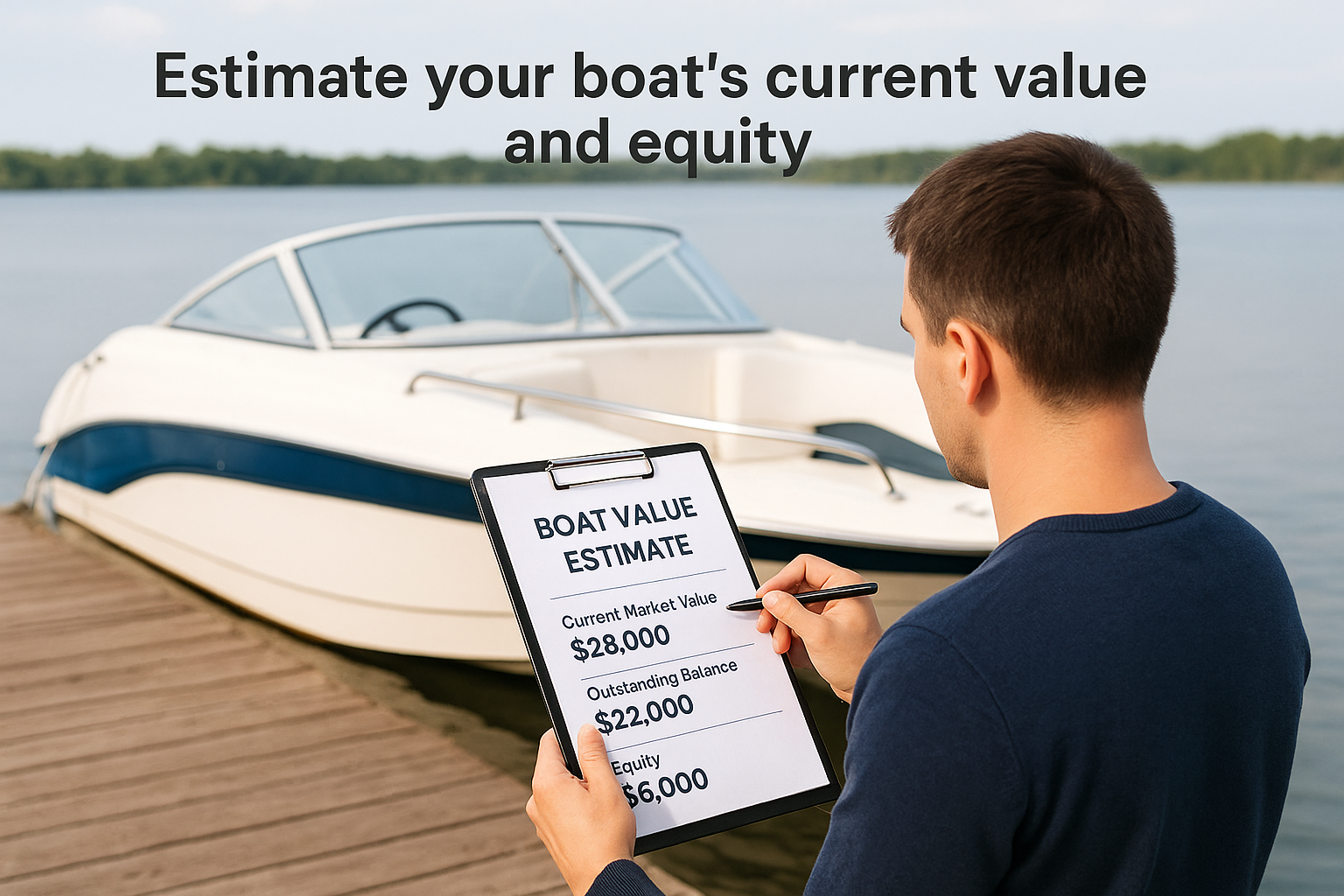
For example, if you owe $22,000 and your boat is currently valued at $28,000, your LTV sits at roughly 79%, which puts you in a favorable spot with most lenders. If your LTV exceeds 90%, consider paying down your balance before applying rather than locking in a worse rate.
Step 3. Compare lenders, rates, and fees
Shopping multiple lenders is where most people leave money on the table when they refinance my boat loan. Getting at least three to five competing offers before choosing a lender gives you real leverage and a concrete baseline for comparison. Aim to submit all applications within a 14-day window, since multiple hard inquiries for the same loan type within that period typically count as a single inquiry on your credit report.
Applying to several lenders in a short window protects your credit score while maximizing your chances of finding the lowest rate available to you.
Where to look for marine lenders
Your starting point should include credit unions, community banks, and online marine lenders, as these consistently offer more competitive rates than dealership financing. Credit unions in particular often carry lower APRs because they operate as nonprofit institutions. When you contact each lender, ask specifically for a marine loan refinance quote rather than a generic personal loan quote, since boats qualify for secured loan rates that are notably lower.
Good sources to check include:
- Your current bank or credit union (existing relationships often unlock better terms)
- National credit unions with open membership, such as Navy Federal or PenFed
- Online marine lenders that specialize in boat and watercraft financing
- Local community banks in waterfront or lake-heavy regions, where marine lending is routine
How to evaluate an offer beyond the rate
The APR gets the most attention, but total loan cost and fee structure matter just as much. Ask every lender for a written breakdown before you accept anything.
Use this comparison table for each offer you receive:
| Factor | Lender A | Lender B | Lender C |
|---|---|---|---|
| APR | |||
| Loan term (months) | |||
| Monthly payment | |||
| Origination fee | |||
| Prepayment penalty | |||
| Total interest paid |
Fill in the total interest paid row by multiplying the monthly payment by the number of months, then subtracting the loan principal. That single number tells you the true cost of each offer.
Step 4. Run the savings calculator and apply
Once you have at least three competing offers in hand, the final step before you refinance my boat loan is to run a side-by-side savings calculation and then move quickly on the best option. Lenders typically hold rate quotes for 30 days, so act before your quotes expire.
Calculate your actual savings
Use the formula below to calculate your total interest cost under your current loan and each refinance offer. The difference between those two figures is your real savings, not a projection based on rate alone.
Savings calculator formula:
Total interest (current loan) = (Monthly payment × Remaining months) - Outstanding balance

Total interest (new loan)     = (New monthly payment × New term months) - Loan amount

Net savings                   = Total interest (current) - Total interest (new) - Fees paid
Plug your numbers into all three rows, then subtract any origination fees or title transfer costs from your net savings figure. If the result is still positive and meaningful given your threshold from Step 1, you have a clear financial case to proceed.
Run the calculation on each competing offer separately, since a lower rate with high fees can easily cost more than a slightly higher rate with no fees.
Submit your application
When you are ready to apply, gather your supporting documents in advance so the process moves without delays. Most marine lenders ask for the same core package.
- Government-issued photo ID
- Proof of income (two recent pay stubs or two years of tax returns if self-employed)
- Most recent loan statement from your current lender
- Boat registration and hull identification number (HIN)
- Proof of marine insurance
Submit to your chosen lender, confirm the payoff amount directly with your existing lender, and review the final loan documents line by line before signing.
Wrap up and next steps
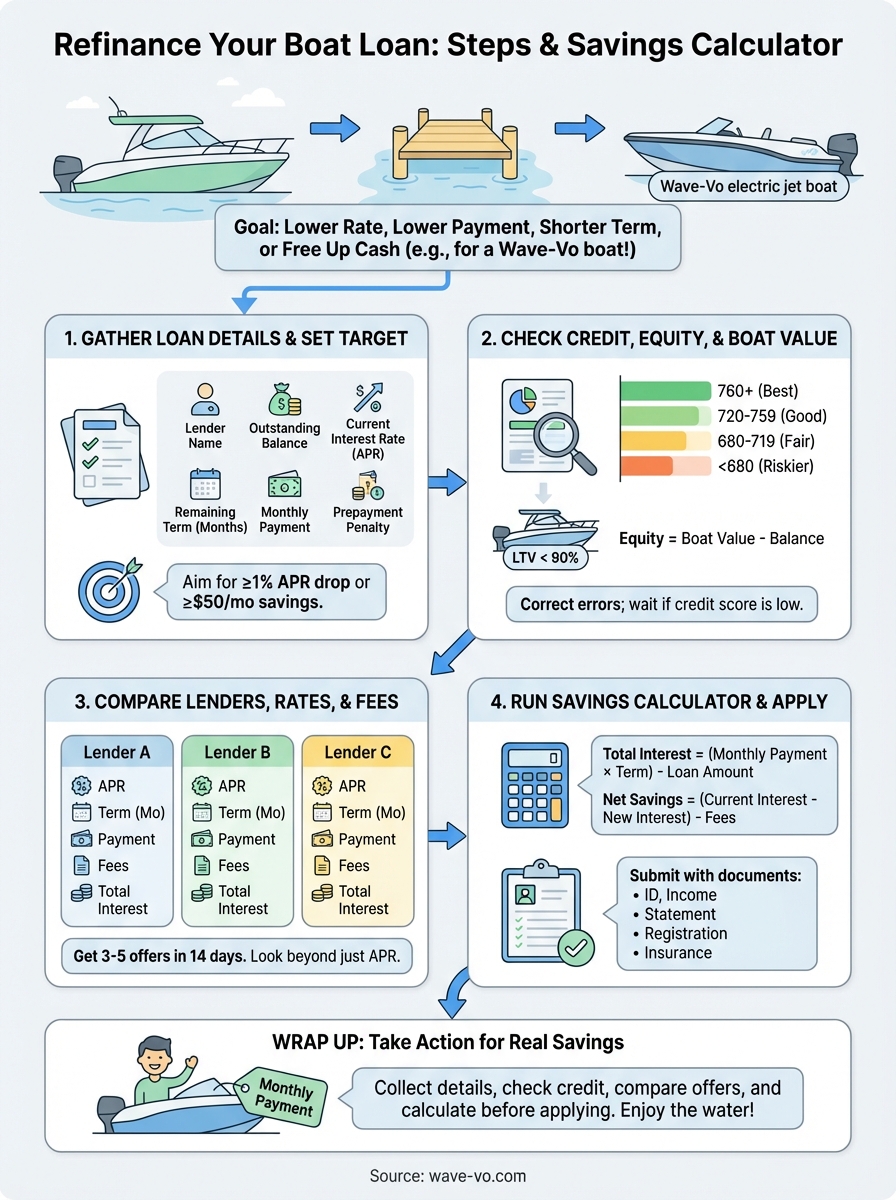
Refinancing a boat loan is a straightforward process when you work through it in the right order. You start by pulling your current loan details, set a savings target, check your credit and equity position, gather competing lender offers, and run the actual numbers before signing anything. Every step in this guide gives you a concrete action to take so that you refinance my boat loan on your terms, not a lender's timeline.
Your next move is to log into your lender's portal today and collect the six loan details from Step 1. That single task takes less than 15 minutes and sets every other step in motion. Once you know your numbers, the rest of the process follows naturally.
If freeing up monthly cash has you thinking about your next watercraft purchase, take a look at the Wave-Vo electric jet boat, a compact, trailer-free option built for people who want more time on the water and less time managing logistics.