
Buying a boat often means taking out a loan, and understanding how does boat financing work can save you thousands of dollars over the life of your purchase. Whether you're eyeing a fishing vessel, a pontoon for family outings, or a high-performance watercraft, the financing process shares similarities with auto loans, but comes with its own set of rules around down payments, interest rates, and repayment terms.
At Wave-Vo, we build electric jet boats that start at $6,999 USD and fit inside your SUV, which means many of our customers skip the financing process entirely. But we also know that traditional watercraft purchases often require loans ranging from $10,000 to $100,000 or more, making it essential to understand your options before signing anything.
This guide breaks down boat loan eligibility requirements, typical interest rates for 2026, the step-by-step application process, and how lenders evaluate your creditworthiness. By the end, you'll know exactly what to expect, and whether financing makes sense for your situation or if a more accessible entry point into water recreation might be the smarter move.
Why boat financing works differently than auto loans
When you compare how does boat financing work versus traditional car loans, the differences become obvious within the first few minutes of research. Banks treat boats as luxury recreational assets rather than necessary transportation, which means you'll face stricter requirements, higher interest rates, and longer repayment periods. Your lender assumes more risk because boats depreciate faster, get used less frequently, and become harder to resell if you default on payments.
Boats depreciate faster and less predictably
Your new boat loses 15% to 25% of its value the moment you leave the dealership, compared to roughly 10% for a new car in the first year. Lenders know that a five-year-old boat might be worth 40% to 60% of its original price, depending on how well you maintained it, where you stored it, and how many hours you put on the engine. Saltwater boats depreciate even faster than freshwater models because corrosion and marine growth damage hulls, motors, and electrical systems more aggressively.
Seasonal markets make boat values swing wildly. If you try to sell in October in Minnesota, you'll get lowball offers because buyers know you're desperate to avoid winter storage costs. Lenders factor this unpredictable resale value into their loan terms by requiring larger down payments and charging higher interest rates to offset the risk they're taking on your collateral.
Boats don't follow the predictable depreciation curves that make auto loans relatively safe for lenders, which is why you'll pay more to borrow the same dollar amount.
Collateral value varies wildly by boat type
Your loan-to-value ratio depends heavily on whether you're financing a bass boat, a yacht, or a pontoon. Banks view fishing boats and performance vessels as more stable collateral because they appeal to broader markets and hold resale value better than highly customized or niche watercraft. If you're financing a houseboat or a sailboat over 40 feet, expect lenders to scrutinize your application more carefully because these boats sit on the market longer when repossessed.
Personal watercraft like jet skis typically require higher down payments (20% to 30%) because they're considered toys rather than serious boats. Lenders see them as impulse purchases that owners abandon quickly, especially after realizing the maintenance costs and storage fees. The same skepticism applies to high-performance boats built purely for speed, which insurers rate as higher risk and banks view as less essential to your lifestyle.
Loan terms stretch longer but rates run higher
You can finance a boat for 15 to 20 years in many cases, compared to the typical 5 to 7 years for auto loans. Longer terms mean smaller monthly payments, but you'll pay thousands more in interest over the life of the loan. Your interest rate will likely sit 2% to 4% higher than comparable auto loan rates because boats don't serve as daily transportation and lenders can't repossess them as easily if you stop paying.
Credit unions and marine-specific lenders often beat traditional banks on rates, but they still charge more than auto lenders because default rates run higher on recreational purchases. If you lose your job, you'll keep making car payments to get to work, but you'll let the boat payment slide since it's not essential. Banks price this reality into every boat loan they write.
Your down payment requirement typically starts at 15% to 20% for new boats and climbs to 25% or higher for used vessels, compared to the 10% that's common for auto loans. Lenders want you to have significant skin in the game before they'll finance something you'll use a few dozen days per year at most.
What boat loans cover and common loan types
Understanding what boat loans actually cover helps you avoid surprises when you're ready to write the check. Most lenders will finance the hull, motor, and trailer as a package deal, but they draw hard lines around add-ons, accessories, and customization work. Your loan amount depends on whether you're buying new or used, how old the boat is, and what type of lender you're working with. Some lenders treat boats under 20 feet differently than larger vessels, which affects both your borrowing limits and the documentation required.
What your boat loan actually pays for
Your lender will cover the purchase price of the boat, the motor, and the trailer in most cases, treating them as a single unit of collateral. Many lenders also finance sales tax, registration fees, and documentation costs directly into your loan, which means you won't need thousands in cash at closing. You'll typically need to pay for insurance, storage, fuel, and initial maintenance out of pocket before your first payment comes due.
Add-ons like upgraded electronics, custom seating, or wakeboard towers often require separate financing or cash payment because lenders view them as removable accessories that don't increase resale value proportionally. If you're buying used, some lenders will finance a mechanical survey or inspection as part of your loan, but others require you to pay upfront and reimburse yourself later. Extended warranties and service contracts rarely qualify for inclusion in your loan amount.
Most boat loans finance the vessel and trailer together, but you'll pay separately for gear, electronics, and customization that doesn't come from the factory.
Secured vs. unsecured boat loans
Secured loans use the boat itself as collateral, which means the lender can repossess it if you stop making payments. You'll get lower interest rates and longer repayment terms with secured financing, but you'll also need to maintain full insurance coverage throughout the loan period. The lender places a lien on your boat's title, and you can't sell or transfer ownership until you pay off the balance.
Unsecured personal loans don't require the boat as collateral, but you'll face interest rates 4% to 8% higher than secured options and shorter repayment periods of 3 to 7 years. Banks typically cap unsecured boat loans at $25,000 to $50,000 because they're taking pure credit risk without an asset to recover.
Where to get boat financing
Banks, credit unions, and marine-specific lenders all write boat loans, but credit unions consistently offer rates 0.5% to 2% lower than traditional banks. Marine lenders like MBNA or Trident Funding specialize in watercraft and understand how does boat financing work better than general-purpose banks, which means they'll approve older boats or unusual models that big banks reject automatically.
Boat loan rates, terms, and down payments in 2026
When you're ready to understand how does boat financing work in practical terms, you need concrete numbers on what rates you'll actually pay and how much cash you'll need upfront. Rates in 2026 range from 6.5% to 12% depending on your credit score, the boat's age, and whether you're borrowing from a credit union or a traditional bank. Your loan term and down payment requirements shift dramatically based on the size and type of watercraft you're purchasing, with larger vessels qualifying for longer terms but requiring bigger initial investments.
Current interest rates for boat loans
Credit unions offer the most competitive rates, typically 6.5% to 8.5% for borrowers with excellent credit (720 or higher) on new boats under 10 years old. Banks charge 8% to 10% for similar profiles, while online lenders and marine-specific financing companies push rates up to 10% to 12% because they approve riskier loans that traditional institutions reject. Your rate jumps 1% to 3% higher if you're financing a used boat over 10 years old, since lenders view older vessels as harder to resell if they need to repossess.
Borrowers with credit scores below 650 face rates of 11% to 14% or higher, assuming they qualify at all. Most lenders won't finance boats for borrowers below 600 unless you put down 30% to 40% upfront to reduce their risk exposure.
Typical loan terms and repayment periods
You can stretch boat financing over 10 to 20 years for new vessels over $50,000, compared to the 5 to 7 years common for auto loans. Boats under $25,000 typically max out at 7 to 10 years, while personal watercraft and smaller boats rarely qualify for terms longer than 5 years. Longer terms reduce your monthly payment but add thousands in total interest, so you'll pay 25% to 40% more over the life of a 20-year loan compared to a 10-year term.
Stretching your boat loan to 15 or 20 years might make the payment affordable, but you'll still be paying for it long after the boat needs major repairs or upgrades.
Down payment requirements by boat type
Lenders require 15% to 20% down for new boats and 20% to 30% for used vessels, with higher percentages applying to personal watercraft and high-performance models. If you're financing a boat over $100,000, expect to put down at least 25% to secure competitive rates. Some credit unions offer 10% down programs for members with excellent credit, but these deals typically apply only to new boats from authorized dealers.
What lenders look for in a boat loan application
Your lender evaluates multiple factors when deciding whether to approve your boat loan, starting with your credit profile and income stability. Banks want proof you can handle the monthly payment without stretching your budget, which means they'll examine your existing debts, employment history, and the boat's value relative to your loan request. Understanding what lenders prioritize helps you strengthen weak areas before you apply, potentially saving you from rejection or getting stuck with rates 2% to 4% higher than borrowers with stronger applications receive.
Credit score and debt-to-income ratio
Lenders set minimum credit score requirements between 650 and 700 for most boat loans, with credit unions occasionally accepting scores as low as 620 if you're financing a newer vessel and putting down 25% or more. Your score determines not just approval but also your interest rate tier, with borrowers above 740 qualifying for the best rates while those between 650 and 700 pay premium pricing. Most banks want to see at least two years of positive credit history with no recent bankruptcies or repossessions.
Your debt-to-income ratio can't exceed 42% to 45% in most cases, meaning your total monthly debt payments (including the proposed boat loan) must stay below that percentage of your gross monthly income. Lenders calculate this by adding your mortgage, car payments, credit cards, student loans, and the new boat payment, then dividing by your monthly income before taxes.
Employment history and income verification
Banks require proof of stable income through recent pay stubs, W-2 forms, or tax returns covering the past two years. Self-employed borrowers face stricter scrutiny because lenders view variable income as riskier, which means you'll need two to three years of tax returns showing consistent or growing earnings. Frequent job changes within the past 24 months trigger red flags, even if your income increased with each move.
Lenders want to see that you've held your current job for at least one year, or stayed in the same industry for three years, before they'll approve a discretionary purchase like a boat.
The boat's age, condition, and loan-to-value ratio
Your lender caps how much they'll finance based on the boat's appraised value and age, typically lending 80% to 85% of the purchase price for new boats and 70% to 80% for used vessels. Boats older than 15 years rarely qualify for financing through traditional banks, though some marine lenders will go up to 20 years old if the hull and motor are in excellent condition. The lender orders a marine survey or inspection for used boats over $25,000 to verify the asking price matches actual market value, and they'll reduce your loan amount if the appraisal comes in low.
How to get boat financing step by step
Applying for boat financing follows a predictable sequence that takes two to four weeks from your initial application to signing the final paperwork. You'll move through credit checks, lender comparisons, formal application submission, and closing, with each phase requiring specific documents and decisions. Understanding how does boat financing work from a process standpoint helps you avoid delays and increases your chances of securing the best available rate instead of settling for whatever your dealer offers first.
Check your credit and gather documents before applying
Pull your credit report from all three bureaus to verify your score sits above 680 before you contact any lenders, since hard inquiries from applications temporarily lower your score by 3 to 5 points each. Fix any errors you find, pay down credit card balances below 30% of your limits, and avoid opening new credit accounts for at least 90 days before applying. Lenders need recent pay stubs covering the last 30 to 60 days, two years of W-2s or tax returns, bank statements from the past three months, and documentation of any additional income sources like rental properties or investments.
Self-employed borrowers should prepare profit and loss statements for the current year along with complete tax returns showing business income. Having everything organized before you apply speeds up approval and prevents lenders from questioning gaps in your financial documentation.
Compare lenders and get pre-approved for your boat loan
Contact at least three to five lenders including your local credit union, traditional banks, and marine-specific financing companies to compare rates and terms. Request pre-approval rather than just rate quotes, since pre-approval locks your rate for 30 to 60 days and shows boat dealers you're a serious buyer with verified financing capacity. Credit unions typically require membership but offer rates 1% to 2% lower than banks, making the small membership fee worthwhile if you qualify.
Getting pre-approved before you shop for boats gives you negotiating power with dealers and prevents them from steering you toward their higher-rate financing partners.
Marine lenders understand boat values better than general banks and approve older vessels more readily, but they charge slightly higher rates as a tradeoff for their flexibility. Compare not just the interest rate but also prepayment penalties, origination fees, and whether the lender requires gap insurance or extended warranties as loan conditions.
Submit your formal application with boat specifications
Once you've selected a boat, submit your complete application including the vessel identification number, purchase agreement, and dealer invoice showing the exact price breakdown. Your lender orders a marine survey for used boats or verifies the manufacturer's invoice for new purchases to confirm the loan amount matches actual market value. Approval typically takes three to seven business days, though complex applications or older boats may require additional documentation or a second appraisal.
Expect the lender to request proof of insurance before closing, which means you'll need to contact marine insurance companies and obtain quotes based on the specific boat model. Your lender also verifies your employment one final time within 10 days of closing to ensure nothing has changed since your initial application.
Review your loan terms and finalize the paperwork
Your lender sends a loan disclosure showing your final interest rate, monthly payment, total interest cost, and repayment schedule at least three business days before closing. Read every page carefully and question any fees or terms that differ from your pre-approval, since some lenders add documentation fees or insurance requirements at the last minute. Sign your paperwork at the dealership or lender's office, provide proof of insurance and registration, and receive the funds either as a direct payment to the dealer or as a check you deliver yourself depending on how your lender structures the disbursement.
Hidden costs and risks of financing a boat
Understanding how does boat financing work extends beyond monthly payments to include mandatory insurance costs, storage fees, and depreciation risks that catch buyers off guard. Your lender's requirements add thousands to your annual ownership costs, while the boat's declining value creates situations where you owe more than the vessel is worth. These hidden expenses often push boat owners into financial stress within the first two to three years of ownership, especially when they financed with minimal down payments or extended loan terms.
Insurance requirements and gap coverage costs
Your lender mandates full coverage marine insurance throughout your loan period, which costs $800 to $2,500 annually depending on the boat's value, your location, and how you use it. Banks also require you to purchase gap insurance that covers the difference between what you owe and what your insurance pays if the boat is totaled or stolen. Gap coverage adds $400 to $800 to your annual insurance bill, and some lenders build this cost directly into your loan instead of letting you shop for competitive rates.
Liability coverage alone won't satisfy your lender since they need protection for their collateral, meaning you'll pay for comprehensive and collision coverage even if you'd prefer to self-insure against minor damage. Missing a single insurance payment triggers default clauses in most loan agreements, giving your lender the right to force-place expensive coverage and bill you for it.
Storage, maintenance, and winterization expenses
You'll spend $1,500 to $5,000 per year on marina fees, dry storage, or winter storage depending on your location and boat size. Many first-time buyers forget these costs when calculating affordability, discovering too late that their $400 monthly loan payment balloons to $700 or more when you include storage and routine maintenance. Winterization costs another $300 to $800 annually in cold climates, covering engine prep, fuel stabilization, and shrink-wrap protection.
Your loan payment represents only 40% to 60% of your true monthly boat ownership cost once you factor in insurance, storage, fuel, and regular maintenance.
Depreciation and negative equity risks
Boats lose 20% to 30% of their value in the first three years, which means you'll owe more than the boat is worth if you financed 85% to 90% of the purchase price. Negative equity traps you in a situation where selling requires you to bring thousands in cash to closing just to pay off your loan balance. This gap widens when you stretch financing over 15 to 20 years, since your principal paydown stays minimal during the early years while depreciation accelerates.
Quick wrap-up
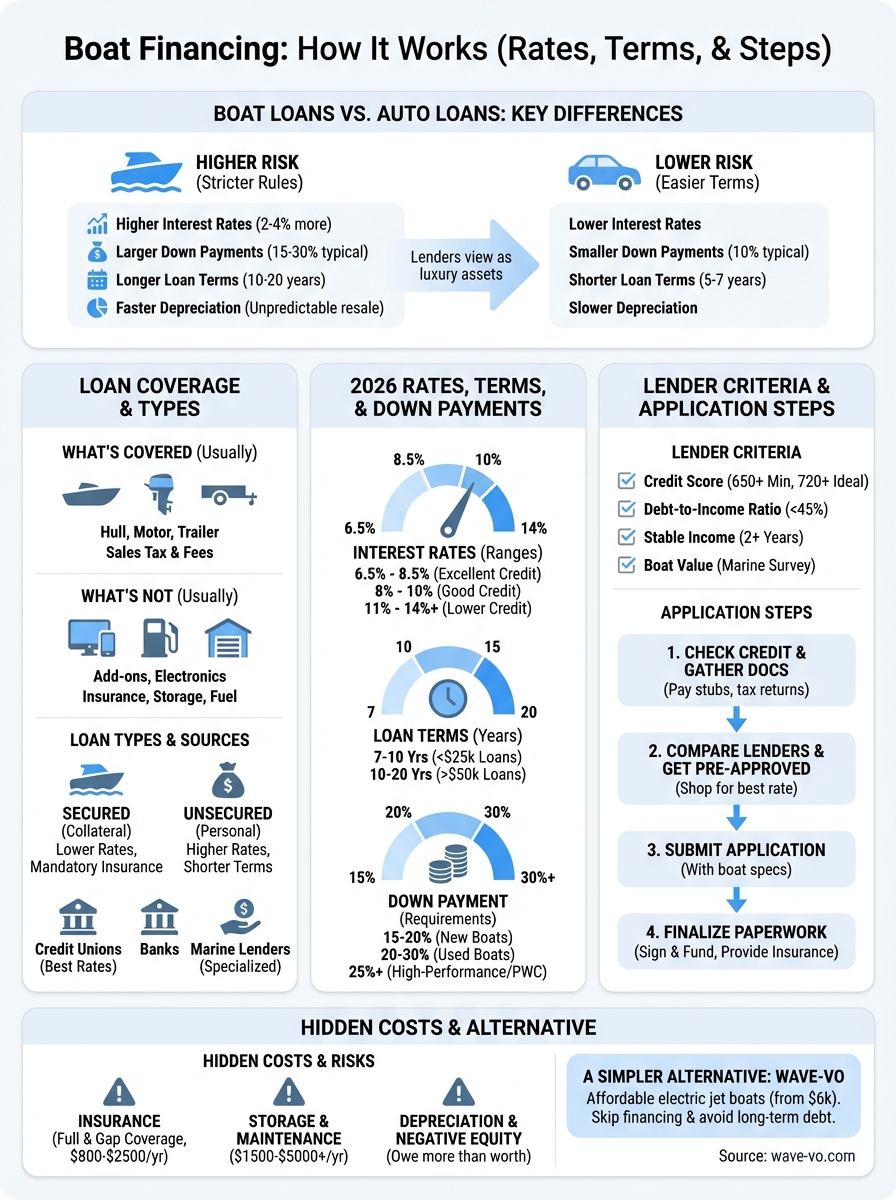
Understanding how does boat financing work gives you the leverage to negotiate better terms, avoid hidden costs, and decide whether borrowing makes sense for your situation. You'll face higher interest rates than auto loans, need 15% to 30% down depending on the boat's age and type, and carry mandatory insurance and storage costs that add thousands annually. Lenders scrutinize your credit score, income stability, and the boat's resale value before approving your application, which takes two to four weeks from start to finish.
At Wave-Vo, we built electric jet boats that start at $6,999 USD and fit inside your SUV specifically to eliminate these financing barriers. You skip the loan application process, avoid paying interest on a depreciating asset, and get on the water without committing to 15 to 20 years of payments. If you're tired of the complexity and cost of traditional boat ownership, check out Wave-Vo's lineup and see how we're making water recreation accessible without the debt.