
Whether you own a traditional watercraft or an electric jet boat like a Wave-Vo, protecting your investment with the right insurance is a smart move. Foremost boat insurance has been a name in the industry for decades, offering coverage options for various types of watercraft. But is it the right fit for your needs? With multiple policy types and coverage levels available, understanding what Foremost actually offers, and what real customers say about their experience, can save you time and money.
This guide breaks down Foremost's boat insurance plans, what's covered (and what's not), how much you can expect to pay, and honest feedback from policyholders. By the end, you'll have a clear picture of whether Foremost deserves your business or if you should keep shopping around for better options.
Why Foremost boat insurance matters
You've invested thousands of dollars in your watercraft, whether it's a traditional boat, jet ski, or electric watercraft. Without proper coverage, a single accident or theft could wipe out that investment overnight. Foremost boat insurance exists to protect you from financial devastation when the unexpected happens on the water. Beyond just replacing your boat, the right policy shields you from liability claims if someone gets injured during your outing or if you accidentally damage another person's property while docking.
Financial protection beyond the sticker price
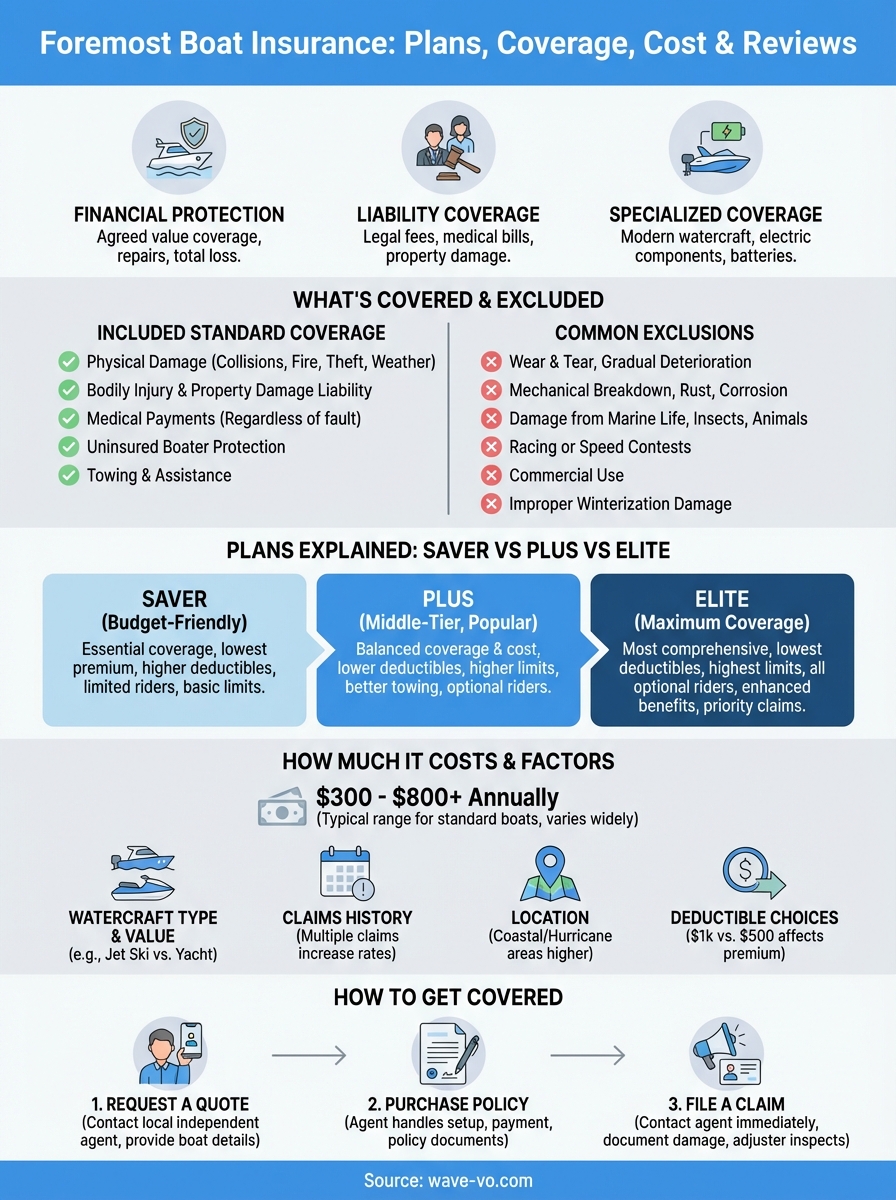
Your boat represents more than just its purchase price. When you factor in equipment upgrades, electronics, and accessories, the total value climbs quickly. If your watercraft sinks, catches fire, or gets stolen from your driveway, you're looking at a massive loss without insurance. Foremost offers agreed value coverage, which means you and the insurer agree upfront on your boat's worth, so you avoid disputes about depreciation when filing a claim. This approach gives you predictable compensation instead of wondering what percentage of your original investment you'll actually recover.
Repairs after collisions or weather damage also add up fast. A cracked hull or damaged propeller can cost thousands to fix, and specialty parts for electric boats like the Wave-Vo may take weeks to source. Insurance covers these repair bills so you're not forced to choose between fixing your boat and paying your mortgage.
Boat owners without insurance face average out-of-pocket costs of $8,000 to $15,000 after major incidents, according to industry estimates.
Liability coverage protects your assets
Accidents on the water put your personal finances and property at risk. If you collide with another boat or injure a swimmer, you could face lawsuits demanding hundreds of thousands in damages. Foremost's liability coverage steps in to pay legal fees, medical bills, and settlement costs so your savings account and home equity stay protected. Without this safety net, a single lawsuit could force you into bankruptcy.
Marina operators and lakefront communities increasingly require proof of insurance before granting access to boat launches or storage facilities. You can't legally operate in many jurisdictions without at least minimum liability coverage, making insurance a practical necessity rather than an optional expense.
Specialized coverage for modern watercraft
Electric boats and personal watercraft face unique risks that traditional policies might not address. Battery systems, electric motors, and electronic controls require specialized replacement and repair knowledge. Foremost has adapted its policies to cover these newer propulsion technologies, ensuring you're not stuck with outdated coverage that excludes critical components. This matters especially if you own a Wave-Vo or similar electric jet boat, where the battery and motor represent the most expensive parts of the entire system.
What Foremost covers and what it excludes
Understanding the boundaries of your coverage prevents nasty surprises when you file a claim. Foremost boat insurance policies include standard protections that apply to most watercraft, but they also contain specific exclusions that could leave you paying out of pocket if you're not careful. Knowing these details upfront helps you decide whether you need additional riders or a different insurer altogether.
Standard coverage inclusions
Foremost covers physical damage to your boat from collisions, fire, theft, vandalism, and weather events like hail or windstorms. Your policy protects the hull, motor, and permanently attached equipment, so if a storm tosses your boat against the dock or someone steals it from your property, you're covered for repairs or replacement. Bodily injury and property damage liability also come standard, protecting you when you accidentally injure someone or damage another person's boat.
The insurer includes coverage for medical payments regardless of fault, which means injured passengers can receive immediate medical care without waiting for liability determinations. Uninsured boater protection kicks in when someone without insurance damages your watercraft, and you'll also get towing and assistance if your boat breaks down on the water.
Foremost's agreed value coverage locks in your boat's worth at policy inception, eliminating depreciation disputes during claims.
Common exclusions you should know
Foremost excludes wear and tear, gradual deterioration, and mechanical breakdown from standard policies. Your engine won't receive coverage if it fails due to lack of maintenance or age, and rust or corrosion damage falls on you to repair. The insurer also won't pay for damage caused by marine life, insects, or animals, so if a family of rats nests in your stored boat and chews through wiring, you're handling that bill yourself.
Racing or speed contests void your coverage entirely, and commercial use of your watercraft isn't protected under personal policies. Damage from improper winterization gets excluded too, which matters if you live in cold climates where freezing can crack engine blocks or hulls.
Foremost plans explained: Saver vs Plus vs Elite
Foremost boat insurance comes in three distinct tiers, each designed to match different budgets and coverage needs. The Saver, Plus, and Elite plans offer progressively more protection, with the main differences showing up in your deductible options, coverage limits, and available add-ons. Choosing the wrong tier could leave you underinsured or paying for protections you'll never use, so understanding what each level delivers helps you make a smarter decision.
Saver plan: Budget-friendly basics
The Saver plan gives you essential coverage at the lowest premium, making it a fit for older boats or owners who keep their watercraft in protected storage most of the year. You'll get standard liability protection, physical damage coverage, and basic medical payments, but your deductible options start higher than the other tiers. This plan limits your ability to add optional coverages like personal effects protection or fishing equipment riders, and you'll face more restrictive coverage limits on things like towing assistance or emergency service calls.
Plus plan: Middle-tier protection
Most boat owners land on the Plus plan because it balances affordable premiums with expanded coverage options. You gain access to lower deductible choices, higher liability limits, and the ability to add riders for personal property, water sports equipment, and trailer coverage. The Plus tier also includes better towing and assistance benefits, typically covering longer distances and higher service costs than the Saver plan. If you use your boat regularly throughout the season or own a newer watercraft worth $20,000 or more, this tier provides solid value without excessive costs.
The Plus plan typically costs 15-25% more than Saver but delivers significantly broader protection and flexibility.
Elite plan: Maximum coverage
Elite represents Foremost's premium tier with the most comprehensive protections available. You'll access the lowest possible deductibles, the highest liability limits (often $500,000 or more), and every optional coverage rider Foremost offers. This plan includes enhanced replacement cost coverage for equipment, better pollution liability protection, and priority claims handling. Elite makes sense if you own high-value watercraft, operate in busy waters, or want absolute peace of mind knowing you're covered for virtually any scenario on the water.
How much Foremost boat insurance costs
Pricing for Foremost boat insurance varies dramatically based on your watercraft type, value, location, and chosen coverage level. You'll typically pay between $300 and $800 annually for basic coverage on a standard boat, but premiums can climb much higher for expensive vessels or comprehensive Elite plans. Understanding what drives these costs helps you budget accurately and identify opportunities to lower your payments without sacrificing essential protection.
Typical price ranges for different watercraft
Your annual premium depends heavily on what you're insuring and where you operate. A basic fishing boat valued under $15,000 might cost you $300 to $450 per year with a Saver plan, while a $40,000 cabin cruiser could run $700 to $1,200 annually. Personal watercraft like jet skis typically fall on the lower end of the spectrum at $200 to $400 per year, and electric boats like the Wave-Vo often land in the $350 to $600 range depending on battery value and equipment.
High-performance boats and yachts push premiums higher because they carry greater replacement costs and liability risks. If you own a vessel worth $100,000 or more, expect to pay $1,500 to $3,000 annually, with Elite coverage potentially exceeding $4,000 in high-risk areas.
Boat insurance premiums represent roughly 1% to 2% of your watercraft's insured value for most standard policies.
Factors that affect your premium
Your claims history plays a massive role in pricing. Multiple claims in recent years signal higher risk to insurers, which translates to steeper premiums or potential coverage denial. Where you store and operate your boat also matters, with coastal areas and hurricane-prone regions commanding higher rates than inland lakes. Your age and boating experience influence costs too, as inexperienced operators under 25 face premiums 20% to 40% above average.
Deductible choices directly impact your payments. Selecting a $1,000 deductible instead of $500 can cut your annual premium by 15% to 25%, though you'll pay more out of pocket when filing claims. Adding optional coverages like fishing equipment riders or increased liability limits raises your total cost, but these additions often deliver worthwhile protection for modest price increases.
How to get a quote, buy a policy, and file a claim
Getting covered by Foremost boat insurance requires navigating three distinct steps: requesting a quote, purchasing your chosen policy, and filing claims when damage occurs. The entire process happens through independent insurance agents rather than directly with Foremost, which means you'll need to locate a licensed agent in your area who represents the company. This agent-based system creates an extra step compared to direct online insurers, but it also gives you personalized guidance when selecting coverage options that match your specific watercraft and usage patterns.
Getting your initial quote
You can't request a Foremost quote online through the company's website. Instead, you'll contact a local independent agent who works with Foremost, provide details about your watercraft (make, model, year, value, storage location), and discuss your coverage needs. Your agent will ask about your boating experience, claims history, and any safety courses you've completed, since these factors influence your premium. Most agents deliver quotes within 24 to 48 hours, though complex or high-value watercraft may require additional underwriting time.
Independent agents typically represent multiple insurers, so they can compare Foremost's rates against competitors during your quote request.
Purchasing your policy
After reviewing your quote and choosing a coverage tier, your agent handles the entire purchasing process including payment setup and documentation. You'll pay your first premium (usually annually or semi-annually) through the agent's office, and they'll send your policy documents and proof of insurance within a few days. Your coverage activates immediately upon payment, allowing you to operate your watercraft legally and with full protection. The agent also sets up your online account access if Foremost offers digital policy management in your state.
Filing a claim when something happens
Contact your agent immediately after an incident to start the claims process, though Foremost also maintains a 24/7 claims hotline for emergencies. Document everything with photos, gather witness information if applicable, and avoid making repairs before an adjuster inspects the damage. Your agent submits the claim on your behalf, and an adjuster contacts you within one to three business days to schedule an inspection. Payment arrives within two to four weeks after the adjuster approves your claim, though straightforward cases sometimes settle faster.
Next steps
You now understand how Foremost boat insurance works, what each plan covers, and what you'll pay for protection. Your next move depends on whether Foremost's agent-based system and coverage options align with your needs. Contact a local independent agent who represents Foremost to request your personalized quote, or compare their rates against competitors your agent also represents. If you already own a watercraft, gather your boat's specifications, value estimate, and storage details before reaching out to speed up the quoting process.
Thinking about upgrading your watercraft altogether? Consider electric alternatives that eliminate gas maintenance, reduce operating costs, and deliver go-kart-style performance on the water. The Wave-Vo electric jet boat fits in your SUV, requires no trailer, and offers hot-swappable batteries for extended ride time. Whether you stick with traditional boats or go electric, protecting your investment with proper insurance remains essential for worry-free time on the water.