
The search for an electric jet boat for sale has gotten more interesting as new models continue hitting the market. Silent motors, instant torque, and zero fuel costs have turned electric watercraft into a legitimate alternative to gas-powered jet skis and personal boats.
At Wave-Vo, we build electric jet boats designed for go-kart-style handling on water, which means we've tested what actually works in this space versus what's just marketing noise. Our 15kW brushless motor and hot-swap battery system came from real trial and error, not spec sheet guesswork.
This guide covers 9 electric jet boats available for purchase right now, with actual specs, pricing, and straight talk about what each model does well. Whether you're chasing tight turns and drifts or looking for a quiet cruiser, the right option is somewhere on this list.
1. Wave-Vo electric jet boat
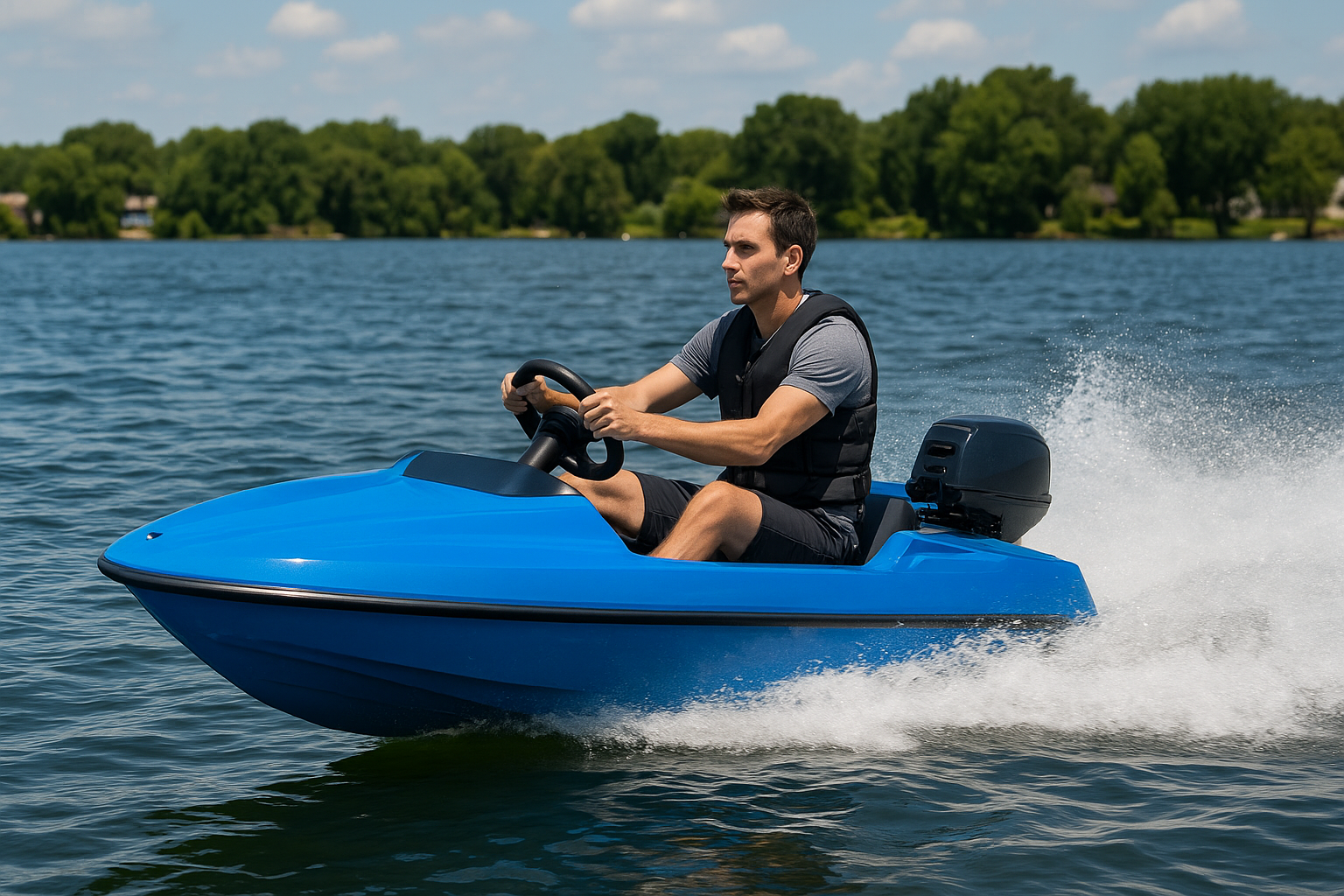
Wave-Vo redesigned the personal watercraft formula from scratch, treating the electric jet boat like a go-kart on water instead of a downsized boat. The 15kW brushless motor delivers instant torque for sharp turns and drifts, while the hot-swap battery system removes the traditional range anxiety that plagues most electric watercraft. You get a 75kg lightweight hull that fits inside an SUV or pickup bed, which cuts out the trailer tax and dock storage costs entirely.
Specs at a glance
The Wave-Vo runs on a 15kW brushless motor that pushes the boat to 50 km/h (31 mph) with zero-to-full acceleration in under 3 seconds. Battery capacity sits at 5.5kWh, and the hull weighs just 75kg without the battery pack. Turning radius measures 1.2 meters, which allows for 360-degree drifts and tight U-turns in spaces where traditional jet skis need three times the room. Controls mimic a go-kart setup with a steering wheel and simple throttle, designed for a 5-minute learning curve even if you've never driven a boat before.
What you get and standout features
Your Wave-Vo ships with the complete hull, motor, steering system, and one 5.5kWh battery with a matching charger. The hot-swap battery system lets you pop a depleted pack out and slot a fresh one in under 10 seconds, no tools required. This approach beats sitting at a charging dock for hours, especially if you buy a second battery and rotate between rides. The compact footprint means you can store the boat in your garage, apartment parking spot, or even a large closet when winter hits. Wave-Vo also includes tie-down straps rated for highway speeds if you're hauling it in a truck bed.
"The hot-swap battery turned what would have been a 2-hour charging wait into a 10-second pit stop, which completely changed how we used the boat during full-day lake trips."
Real-world range and battery swap approach
Expect 45 to 60 minutes of active riding on a single 5.5kWh battery, depending on how aggressively you throttle and drift. Casual cruising at half-speed stretches that closer to 90 minutes, while constant full-throttle runs drain the pack faster. Charging a depleted battery takes 4 to 5 hours on a standard 110V outlet or 2 hours with a 220V setup if you wire one up. Most Wave-Vo owners who want all-day access buy a second battery and swap between them, which gives you continuous ride time while one pack charges in the vehicle.
Pros, cons, and dealbreakers
Wave-Vo wins on portability, swap speed, and precise handling that feels more like racing a kart than driving a boat. The lightweight build makes solo loading simple, and the silent motor keeps you off the radar of lake patrols enforcing noise rules. Downsides include the single-rider design, which limits you if you want to bring a passenger, and the price of a second battery adds another chunk to your upfront cost. The hull also sits low to the water, so rough chop or wakes from larger boats can splash over the sides if you're not careful.
Price, warranty, and shipping notes
The Wave-Vo starts at $6,000 USD for the base package with one battery and charger. A second battery runs roughly $1,200 to $1,500, depending on current pricing. Wave-Vo ships worldwide and includes a 1-year warranty covering the motor, hull, and electrical components, plus a 14-day return policy if the boat doesn't match your expectations. Shipping costs vary by region, but domestic US orders typically add $200 to $400 depending on your distance from the warehouse. International buyers should confirm import duties and local voltage compatibility before placing an order.
2. Havospark electric mini jet boat
Havospark builds compact electric jet boats aimed at recreational riders who want a low-maintenance alternative to gas-powered personal watercraft. The design prioritizes simplicity over performance, with a focus on stable handling for beginners rather than aggressive maneuvers. You get a fiberglass hull that handles calm lake conditions well but doesn't push the boundaries on speed or turning radius.
Specs at a glance
The Havospark runs a 10kW motor that tops out around 35 km/h (22 mph), which places it in the cruising category rather than the performance tier. Hull dimensions measure roughly 2.5 meters long with a beam of 1 meter, and total weight sits near 85kg with the battery installed. Turning radius falls in the 2.5 to 3 meter range, adequate for basic navigation but noticeably wider than more agile designs. Controls use a handlebar steering system similar to a jet ski, which feels familiar if you've ridden traditional personal watercraft before.
Hull size, capacity, and intended use
Havospark's hull accommodates one rider up to 100kg (220 lbs), so you sacrifice passenger capability for the compact footprint. The boat works best on flat lakes, slow rivers, and protected bays where wave action stays minimal. Freeboard height keeps most splashing out during calm conditions, but choppy water or boat wakes will test the limits quickly. You can transport the Havospark in a mid-size SUV or pickup bed without requiring a trailer, though loading solo takes more effort than lighter models.
"The Havospark turned lake mornings into a quiet ritual without waking up the entire shoreline, which mattered more than outrunning other boats."
Battery, charging, and run-time expectations
Havospark includes a 4.8kWh battery pack that delivers 50 to 70 minutes of ride time depending on your throttle habits. Charging from empty takes 5 to 6 hours on a standard household outlet, and the battery doesn't support hot-swapping like some competitors. Plan your sessions around the single-battery limitation, which means you're done for the day once the pack drains unless you wait through a full charge cycle.
Pros, cons, and dealbreakers
Havospark wins on affordability and beginner-friendly handling, making it a solid entry point if you've never driven an electric jet boat for sale before. The stable hull builds confidence for new riders, and maintenance stays minimal with the electric drivetrain. Downsides include the fixed battery, which eliminates extended ride sessions, and the slower top speed limits your options if you later want more performance. Build quality feels adequate but not premium, so expect some cosmetic wear after a season of regular use.
Price and buying options
The Havospark typically sells for $4,500 to $5,200 USD depending on current promotions and battery configuration. Most purchases happen through direct import from Asian manufacturers, so factor in shipping costs of $300 to $600 and potential customs duties. Warranty coverage varies by seller, with some offering 6 months on electrical components while others provide 1 year on the hull and motor.
3. Rush Wave K2 electric go kart boat
Rush Wave designed the K2 to deliver go-kart handling on water without the complexity of traditional boat controls. The company focused on creating an electric jet boat for sale that prioritizes responsive steering and drift capability over straight-line cruising speed. You get a hull built for tight maneuvers in spaces where larger watercraft struggle to navigate.
Specs at a glance
The K2 runs a 12kW motor that pushes speeds up to 40 km/h (25 mph), placing it between cruiser and performance categories. Hull weight sits around 80kg with the battery installed, and overall length measures 2.3 meters with a 1.1 meter beam. Turning radius comes in at 1.5 to 1.8 meters, which allows for sharp turns but doesn't match the tightest performers on the market. Controls use a steering wheel and foot throttle arrangement that mimics driving a racing kart rather than operating a boat.
Handling and "kart on water" feel
Rush Wave tuned the K2's steering response to feel immediate when you rotate the wheel, which translates throttle inputs into directional changes faster than standard jet boats. The hull stays flat during turns rather than leaning, so you maintain control through aggressive maneuvers without fighting the boat's natural tendency to roll. Drift capability exists but requires practice to execute smoothly, especially in choppy conditions where wave action disrupts your line.
"The K2 finally made sense when I stopped treating it like a boat and started driving it like a kart, leaning into turns and using throttle to control slides."
Battery, charging, and parts support
The K2 ships with a 5.2kWh battery that provides 55 to 75 minutes of ride time depending on throttle use. Charging takes 4 to 5 hours on a standard outlet, and the battery doesn't support hot-swapping. Parts availability depends on your region, with better support in Asian markets than North America or Europe.
Pros, cons, and dealbreakers
Rush Wave wins on responsive handling and a familiar control layout for anyone who's driven a kart. The fixed battery limits extended sessions, and parts sourcing outside Asia adds delays if components fail.
Price and typical purchase flow
The K2 typically sells for $5,300 to $6,000 USD through direct import channels. Shipping adds $400 to $700 depending on destination, and warranty coverage varies by seller between 6 months and 1 year.
4. AdmitJet ST-AK15 15 kW mini jet boat
AdmitJet positions the ST-AK15 as a performance-oriented option in the mini jet boat category, matching the higher motor output you see in models like the Wave-Vo while keeping costs competitive with mid-tier imports. The design leans toward traditional jet ski ergonomics rather than the go-kart approach, which means handlebar steering and a seated riding position that feels familiar if you've operated gas-powered personal watercraft before.
Specs at a glance
The ST-AK15 runs a 15kW brushless motor that reaches 48 km/h (30 mph), putting it near the top of the speed range for this size class. Hull length measures 2.6 meters with a 1.2 meter beam, and total weight sits around 90kg including the battery. Turning radius falls between 2 to 2.5 meters, which handles well enough for recreational use but lacks the drift precision of tighter-turning competitors. The hull uses fiberglass construction reinforced at stress points, and weight capacity allows for one rider up to 110kg (242 lbs).
Performance and control layout
AdmitJet uses handlebar steering with thumb throttle controls that mirror traditional jet ski operation, so you skip the learning curve if you've ridden gas models before. The 15kW motor delivers strong acceleration out of the hole, though not quite as aggressive as the sub-3-second sprints from lighter boats. Handling stays predictable through turns without the snap response that go-kart-style designs offer, which some riders prefer for relaxed cruising over aggressive maneuvering.
"The ST-AK15 felt less intimidating than kart-style boats when teaching my teenager to ride, since the handlebar setup matched what she already knew from jet skis."
Battery setup and charging requirements
The ST-AK15 ships with a 6kWh battery pack that provides 60 to 80 minutes of ride time under mixed throttle use. Charging takes 5 to 6 hours on 110V household power, and the battery doesn't support hot-swapping. You commit to single-session rides unless you plan breaks around charging cycles.
Pros, cons, and dealbreakers
AdmitJet wins on motor power and familiar controls for jet ski veterans looking to switch electric. The fixed battery limits all-day use, and the wider turning radius reduces your options for tight-space maneuvering.
Price and shipping considerations
The ST-AK15 typically sells for $5,800 to $6,500 USD through direct import channels. Shipping adds $400 to $800 depending on your location, and warranty coverage ranges from 6 months to 1 year on electrical components.
5. Colton Yacht electric karting boat FRP jet boat
Colton Yacht manufactures this FRP (fiberglass reinforced plastic) jet boat through direct factory channels, targeting buyers who want a durable hull at import pricing. The design prioritizes structural integrity over cutting-edge features, which translates to a boat that handles regular use without constant repairs but lacks some of the refinement you find in established brands.
Specs at a glance
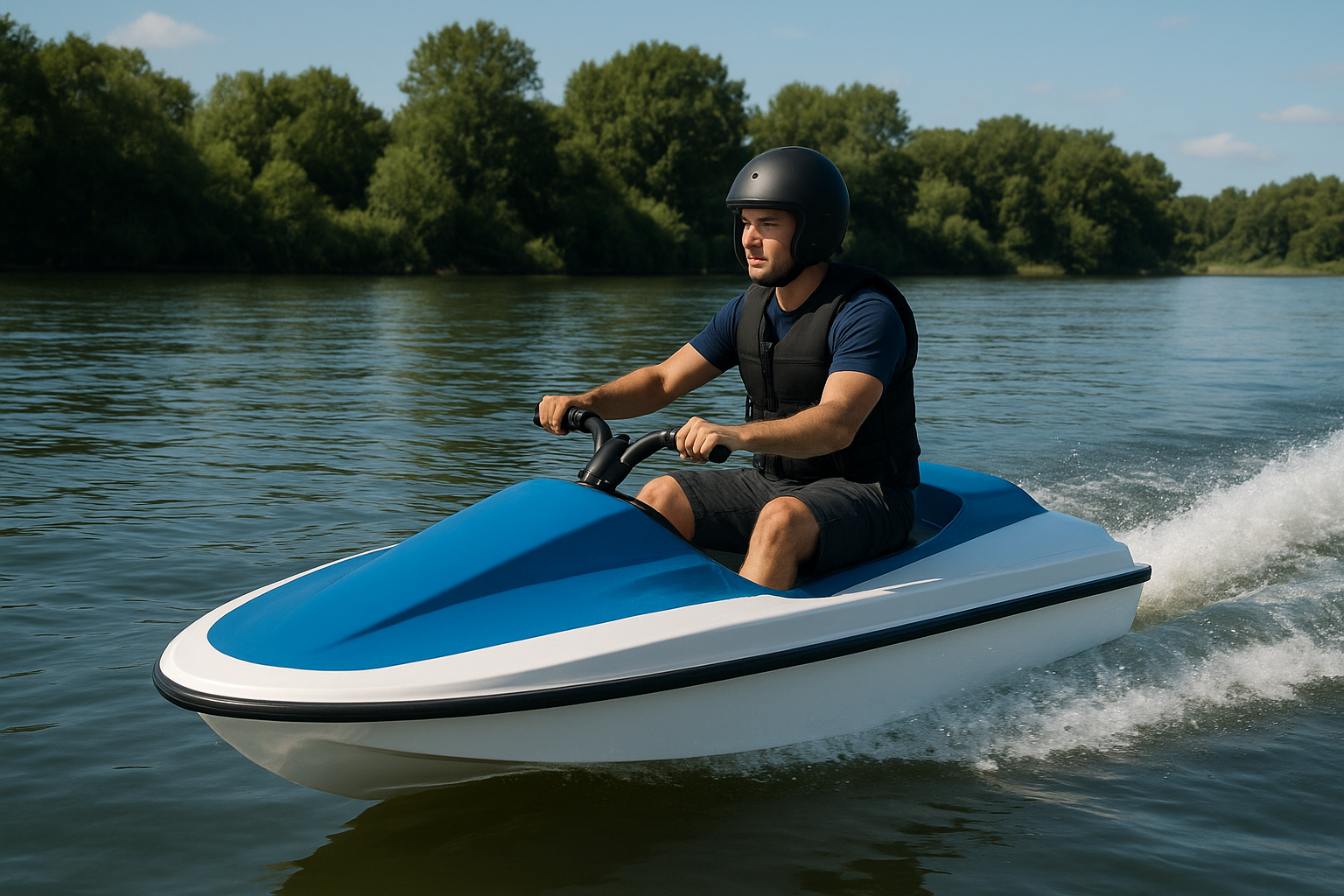
The Colton Yacht model runs a 12kW motor that reaches speeds around 42 km/h (26 mph), placing it in the middle performance bracket. Hull construction uses FRP composite measuring roughly 2.5 meters long with a 1.15 meter beam, and total weight sits near 95kg with battery installed. Turning radius measures 2 to 2.3 meters, adequate for recreational turns but not tight enough for competitive drifting. Weight capacity allows one rider up to 105kg (231 lbs), and controls use handlebar steering with grip throttle similar to motorcycle operation.
Build materials and durability expectations
Colton Yacht's FRP construction delivers better impact resistance than basic fiberglass, especially around the jet intake area where debris contact happens most often. The composite layup includes reinforced stress points at mounting brackets and steering pivots, which reduces cracking from repeated use. Expect the hull to hold up through multiple seasons of regular lake riding, though gel coat fading and minor surface scratches accumulate faster than premium finishes.
Jet system basics and maintenance needs
The jet propulsion system uses a centrifugal impeller design that requires minimal maintenance beyond periodic visual inspections for debris. You flush the intake after riding in silty water to prevent buildup, which takes about five minutes with a garden hose. Motor bearings need annual greasing if you ride frequently, though most owners skip this until performance drops noticeably.
"The FRP hull took hits from submerged logs that would have cracked cheaper boats, which justified the slightly higher price when repairs never materialized."
Pros, cons, and dealbreakers
Colton Yacht wins on hull durability and straightforward maintenance compared to thinner competitors. The heavier weight makes solo loading harder, and build quality varies between production runs depending on factory oversight.
Price and ordering details
This electric jet boat for sale typically runs $5,600 to $6,300 USD through Alibaba or direct manufacturer contact. Shipping adds $500 to $900 depending on port distance, and warranty coverage usually extends 6 months on electrical components with 1 year on hull structure.
6. Hoverstar electric mini jet boat
Hoverstar markets this mini jet boat as a budget-conscious entry point into electric watercraft ownership, targeting riders who prioritize cost savings over cutting-edge performance. The design follows conventional jet boat proportions with a wider hull and higher freeboard than go-kart-style competitors, which trades agility for stability in varied water conditions. You get a functional watercraft that covers basic recreational needs without the feature refinement found in premium models.
Specs at a glance
The Hoverstar runs an 11kW motor that reaches speeds around 38 km/h (24 mph), sitting squarely in the recreational cruising category. Hull dimensions measure approximately 2.4 meters long with a 1.1 meter beam, and total weight lands near 88kg with the battery pack installed. Turning radius falls between 2.2 to 2.6 meters, which handles open water navigation fine but limits your ability to thread tight channels or execute sharp reversals. The boat accommodates one rider up to 100kg (220 lbs), and controls use a handlebar setup with twist-grip throttle operation.
Fit, finish, and comfort considerations
Hoverstar's build quality reflects its budget positioning, with visible seams in the fiberglass work and basic padding on contact surfaces. The seat uses thin foam cushioning that compresses quickly during extended rides, so plan on adding aftermarket padding if you spend more than an hour on the water. Hull finish shows minor inconsistencies in gel coat application, though these cosmetic issues don't typically affect structural integrity or waterproofing.
Battery, charger type, and charging time
The Hoverstar includes a 5kWh battery pack that delivers 50 to 65 minutes of mixed-use ride time depending on throttle habits. Charging relies on a basic 110V charger that takes 6 to 7 hours to fully replenish a depleted battery, longer than most competitors in this price range. The charger uses standard household outlets without requiring special electrical work, which keeps installation costs down.
"The Hoverstar's longer charging time meant we planned lake trips around morning sessions rather than trying to squeeze in afternoon runs, which worked fine once we adjusted expectations."
Pros, cons, and dealbreakers
Hoverstar wins on upfront affordability for buyers entering the electric watercraft space cautiously. The extended charging time limits flexibility, and basic comfort features wear faster than refined competitors.
Price and availability
This electric jet boat for sale typically costs $4,200 to $4,800 USD through direct import channels. Shipping adds $350 to $600 depending on destination, and warranty coverage usually spans 6 months on electrical components.
7. Generic 30 mph mini electric jet boat import
Generic mini jet boats flood import platforms like Alibaba with similar designs manufactured across multiple Chinese factories, typically advertising 30 mph top speeds and bare-minimum specifications. These boats represent the absolute bottom tier of pricing but come with corresponding trade-offs in build quality, component reliability, and post-purchase support. You gamble on factory consistency when ordering direct from manufacturers you can't easily verify.
Specs at a glance
Most generic imports run 10 to 12kW motors that reach claimed speeds of 48 km/h (30 mph), though real-world performance often falls short by 5 to 10 km/h depending on rider weight and water conditions. Hull dimensions typically measure 2.3 to 2.5 meters long with basic fiberglass construction that varies in thickness between production batches. Weight ranges from 80 to 95kg with battery installed, and turning radius sits around 2.5 to 3 meters for standard navigation rather than tight maneuvering.
What to expect when importing direct
You communicate with factory sales representatives through messaging apps or email, often dealing with language barriers that complicate technical questions. Quality control depends entirely on which production line handles your order, so hull finish, electrical connections, and component alignment vary widely. Expect minimal documentation, basic assembly instructions with translation errors, and zero local service support if components fail after delivery.
Battery, charger power, and outlet requirements
Generic imports include 4.5 to 5.5kWh battery packs with basic chargers that typically require 110V to 220V input depending on your region. Charging times stretch 6 to 8 hours due to lower-power charger units, and you verify outlet compatibility before ordering since adapters don't always handle the full amperage draw safely.
Pros, cons, and dealbreakers
Generic imports win purely on rock-bottom pricing for buyers treating this electric jet boat for sale as a disposable experiment. Build inconsistencies, zero warranty enforcement, and parts sourcing difficulties make long-term ownership challenging.
"The generic import worked fine for two months before the motor controller failed, then I learned the factory had gone silent and replacement parts meant buying from scratch."
Total cost estimate: product, freight, duty, fees
Base pricing typically runs $3,500 to $4,200 USD for the boat itself. Freight adds $600 to $1,000 for container shipping, customs duty ranges 5 to 10 percent depending on classification, and port handling fees tack on another $150 to $300. Total landed cost hits $4,500 to $5,800 USD before local transport.
8. 10 kW aluminum electric jet boat listings
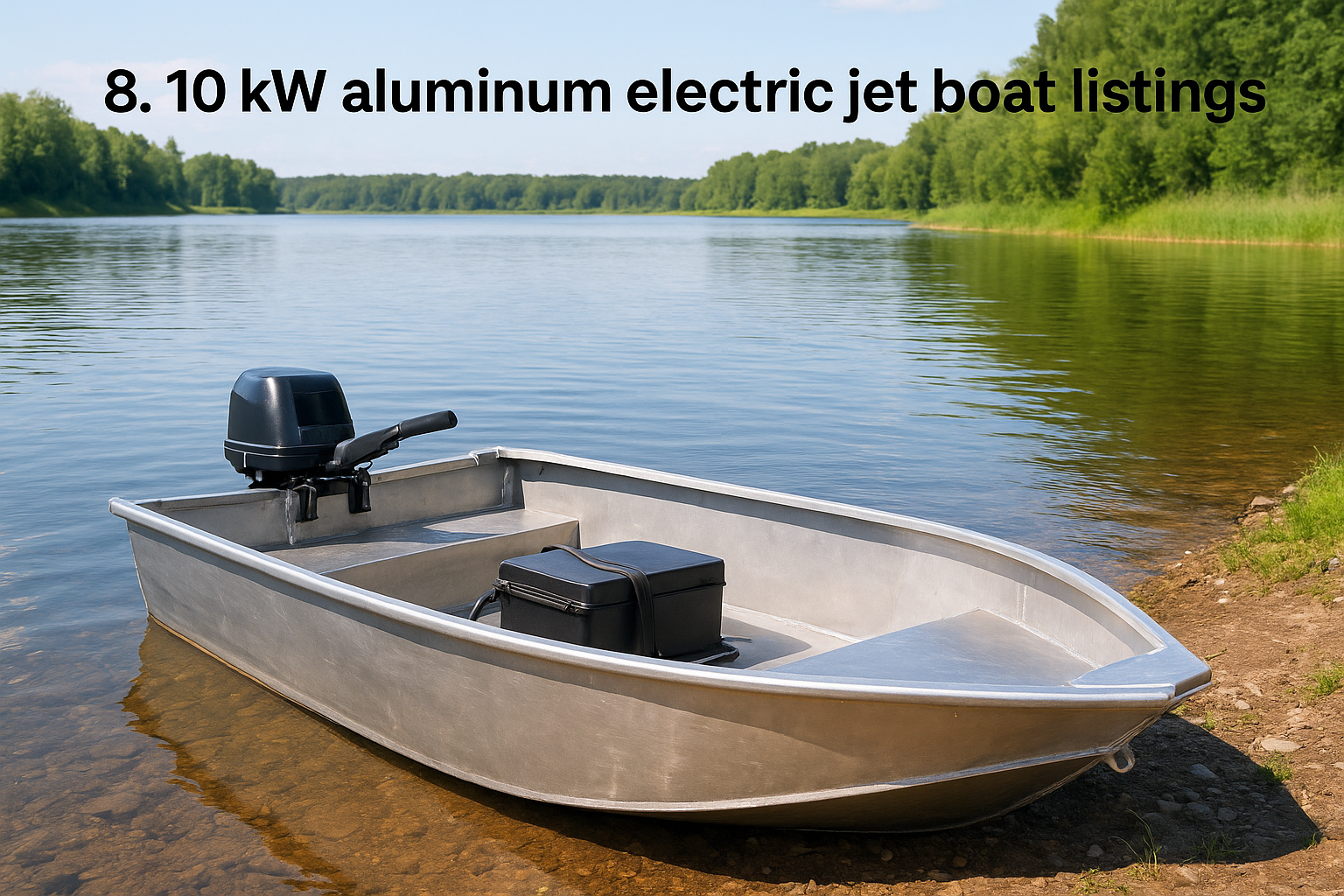
Aluminum hull construction shows up frequently in 10kW electric jet boat listings across import platforms, offering lighter weight and better corrosion resistance than fiberglass alternatives at similar price points. These boats typically come from smaller manufacturers or custom fabrication shops rather than established brands, which means you evaluate each seller individually instead of relying on company reputation. The aluminum construction approach appeals to DIY-oriented buyers who plan modifications or repairs using standard metalworking tools.
Specs at a glance
Most 10kW aluminum models measure 2.2 to 2.4 meters long with hull weight between 65 to 75kg before battery installation, making them among the lightest options available. Motor output sits at 10kW continuous with speeds reaching 35 to 38 km/h (22 to 24 mph) depending on rider weight and water conditions. Hull construction uses marine-grade aluminum in 3mm to 4mm thickness, welded at stress points rather than riveted. Turning radius typically falls around 2.5 to 3 meters, suitable for open water cruising rather than tight maneuvering. Weight capacity ranges from 90 to 110kg (198 to 242 lbs) depending on hull reinforcement and design.
Best use cases: lakes, rivers, calm water
You get the best performance from aluminum 10kW boats on protected lakes and slow-moving rivers where wave action stays minimal and debris encounters remain infrequent. The lighter hull weight makes transport and solo launching easier, but also means rougher water conditions knock you around more than heavier competitors. These boats work well for morning cruises, fishing access, and casual exploration rather than aggressive riding or drift practice. Aluminum construction handles fresh water better than salt water environments, where corrosion accelerates even with marine-grade alloys.
Battery compatibility and upgrade questions to ask
Most aluminum listings ship with 4.5 to 5kWh battery packs using various cell chemistries and form factors that don't always interchange between manufacturers. You confirm physical battery dimensions, voltage specifications, and connector types before ordering since "standard" configurations vary widely across builders. Ask sellers about upgrade pathways to higher capacity packs and whether the motor controller handles increased amperage draw if you later want extended range.
Pros, cons, and dealbreakers
Aluminum construction wins on corrosion resistance, repair accessibility, and weight savings compared to fiberglass builds. Skilled welders can fix hull damage using common equipment, which beats sourcing specialized composite materials. Downsides include poor quality control across different fabrication shops and virtually zero warranty support if components fail after delivery. Hull rigidity varies depending on design, so some aluminum boats develop flexing or vibration issues that fiberglass construction naturally dampens.
"The aluminum hull let me repair a cracked weld with basic shop equipment instead of hunting down composite repair specialists, which saved the boat when damage happened mid-season."
Price bands and how to vet a seller
Expect $3,800 to $5,200 USD for complete aluminum 10kW boats through direct import channels. You research seller history through platform transaction records, buyer reviews, and response time patterns before committing funds. Request detailed photos showing weld quality, electrical connections, and battery installation rather than relying on stock images that hide construction shortcuts.
9. ZeroJet-powered mini jet boat builds
ZeroJet manufactures electric drivetrain systems that independent boat builders integrate into custom hull designs, creating a category where you buy the propulsion components separately from the watercraft frame. This approach appeals to fabrication shops and DIY enthusiasts who want electric performance without committing to mass-produced hull designs. You source the motor, controller, and battery system from ZeroJet, then pair it with aluminum or fiberglass hulls built to your specifications.
Specs at a glance
ZeroJet offers powertrain kits ranging from 10kW to 18kW continuous output, with motor options that reach top speeds between 38 to 52 km/h depending on hull weight and design. The system includes a brushless motor, waterproof controller, throttle assembly, and mounting hardware designed for jet propulsion applications. Battery configurations typically run 5 to 7kWh depending on your range requirements, though ZeroJet sells power units without batteries to let you choose compatible packs separately. Total powertrain weight sits between 25 to 35kg before adding hull structure.
Who should choose a powertrain-led option
You benefit from this electric jet boat for sale approach if you already work with boat fabrication, metal forming, or composite layup and want custom proportions that production models don't offer. Builders creating specialized hulls for fishing, photography platforms, or unique water conditions gain flexibility by selecting powertrain specs that match their intended use case. This route also works for repair shops replacing failed gas engines in existing jet boat hulls with electric conversions.
Integration, serviceability, and support questions
ZeroJet provides technical documentation and wiring diagrams for powertrain installation, but you handle hull integration, waterproofing, and system testing independently. Ask about controller compatibility with third-party batteries and whether firmware updates require factory access or happen through user-accessible interfaces. Verify warranty terms specifically cover powertrain components rather than complete boat assemblies, since ZeroJet doesn't control hull quality.
"The ZeroJet kit let us build a wider hull for camera gear that production boats couldn't accommodate, though we spent more time troubleshooting electrical connections than anticipated."
Pros, cons, and dealbreakers
ZeroJet wins on customization flexibility and access to quality electric components without buying a complete boat. You skip the hull limitations of mass production but take on full responsibility for integration quality and troubleshooting.
Price expectations and how buying works
ZeroJet powertrains cost $2,800 to $4,500 USD depending on motor output and included components. You order directly through ZeroJet's industrial sales channels, though lead times stretch 6 to 10 weeks for custom configurations.
Next steps
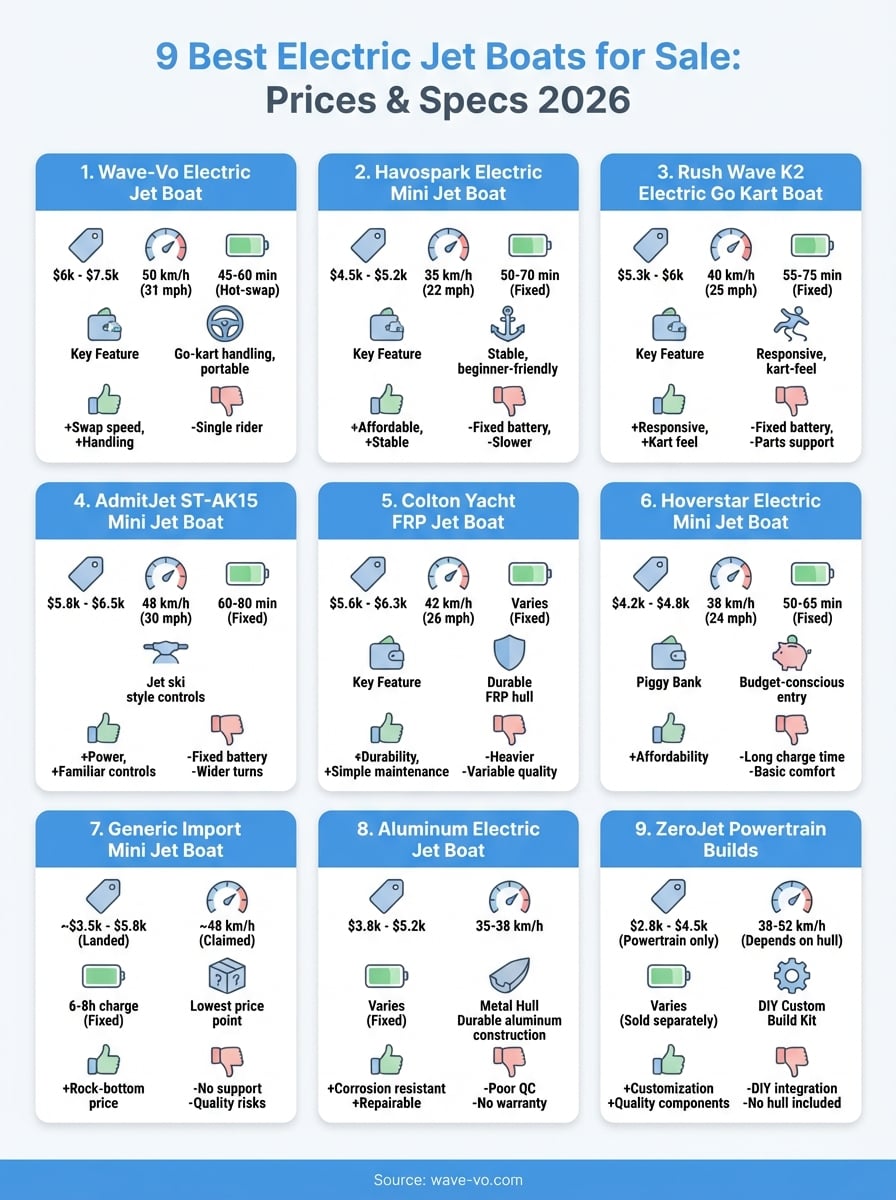
You now have pricing, specs, and real-world context for nine electric jet boats for sale across different performance tiers and budget ranges. The motor power, battery approach, and hull design directly affect how each boat performs on the water, which means matching your budget to your intended use case matters more than chasing the highest specs on paper.
Start by testing your vehicle's cargo capacity and confirming whether you need trailer-free transport or can handle traditional boat hauling. Factor in whether hot-swap battery systems or single-pack setups fit your riding patterns better. Most buyers underestimate how much charging downtime affects full-day lake trips until they experience it firsthand.
Wave-Vo builds electric jet boats with go-kart handling and 10-second battery swaps that eliminate the trailer requirement entirely. Check out our complete specifications and ordering details to see if the approach matches what you're looking for.