
If you've recently purchased a personal watercraft, or you're considering one, you've probably asked yourself: do you need insurance for a jet ski? The short answer depends on where you live and where you ride. Most states don't legally require it, but that doesn't mean going without coverage is a smart financial decision.
Jet ski insurance sits in a gray area between "technically optional" and "practically essential." Liability claims from watercraft accidents can easily reach six figures, and a single collision could put your savings at serious risk. Factor in theft, storm damage, and marina requirements, and the picture gets more complicated fast.
Whether you own a traditional gas-powered jet ski or an electric personal watercraft like a Wave-Vo, understanding your coverage options protects both your investment and your peace of mind. This guide breaks down state-by-state legal requirements, explains the types of coverage available, and helps you determine what level of protection actually makes sense for how and where you ride.
What jet ski insurance covers
Jet ski insurance operates similarly to auto insurance but with watercraft-specific protections. Standard policies typically include both physical damage coverage and liability protection, though the exact combination depends on whether you choose comprehensive, collision, or liability-only options. Most insurers structure their policies around four core coverage types that address the unique risks of operating personal watercraft.
Physical damage protection
Your policy protects the watercraft itself against collision damage, theft, vandalism, and weather-related losses. Collision coverage pays for repairs after you hit another boat, a dock, or underwater debris. Comprehensive coverage handles non-collision incidents like fire, hail, windstorms, or a trailer accident while transporting your jet ski. If someone steals your watercraft from storage or while docked at a marina, this portion of your policy covers replacement costs up to the agreed value.
Liability coverage
This protection kicks in when you injure someone or damage property while operating your jet ski. Bodily injury liability covers medical expenses, lost wages, and legal fees if you cause an accident that hurts another person on the water. Property damage liability pays for repairs to boats, docks, or other structures you damage during operation. Courts often award substantial settlements in watercraft accidents, making liability coverage the most critical component when considering whether do you need insurance for a jet ski.
Most liability claims from jet ski accidents exceed $50,000, with serious injury cases reaching well into six figures.
Additional protections
Beyond the basics, you can add on-water towing and assistance coverage that reimburses emergency services if your watercraft breaks down miles from shore. Uninsured boater coverage protects you financially if another operator without insurance causes an accident. Personal effects coverage reimburses lost or damaged gear like wetsuits, life jackets, and accessories stored on your watercraft.
Why jet ski insurance matters
You face substantial financial exposure every time you operate a personal watercraft. Medical bills from watercraft accidents routinely exceed $100,000, and if you seriously injure another person, you could face lawsuits that wipe out your savings and future earnings. Property damage claims add up quickly when you consider the cost of repairing fiberglass hulls, replacing damaged docks, or compensating other boaters for their losses.
Personal liability exceeds the watercraft value
Your investment in the jet ski itself represents just one piece of your risk profile. Liability claims follow you personally, meaning plaintiffs can pursue your home equity, retirement accounts, and wages if damages exceed your coverage limits. Courts routinely award six-figure judgments in boating injury cases, and without insurance, you become personally responsible for every dollar.
A single jet ski accident resulting in serious injury can lead to settlements exceeding $500,000 in medical expenses and legal fees.
Uninsured operation puts your entire financial future at risk when weighing whether do you need insurance for a jet ski. One accident could eliminate decades of financial security you've worked to build.
Access and financing requirements
Banks won't finance your purchase without comprehensive coverage protecting their collateral. Marinas and lakefront associations frequently mandate proof of insurance before granting access to docks or launch facilities, and rental dock agreements typically require minimum liability limits of $300,000 to $500,000. Violation of these terms results in immediate termination of your access privileges.
When jet ski insurance is required
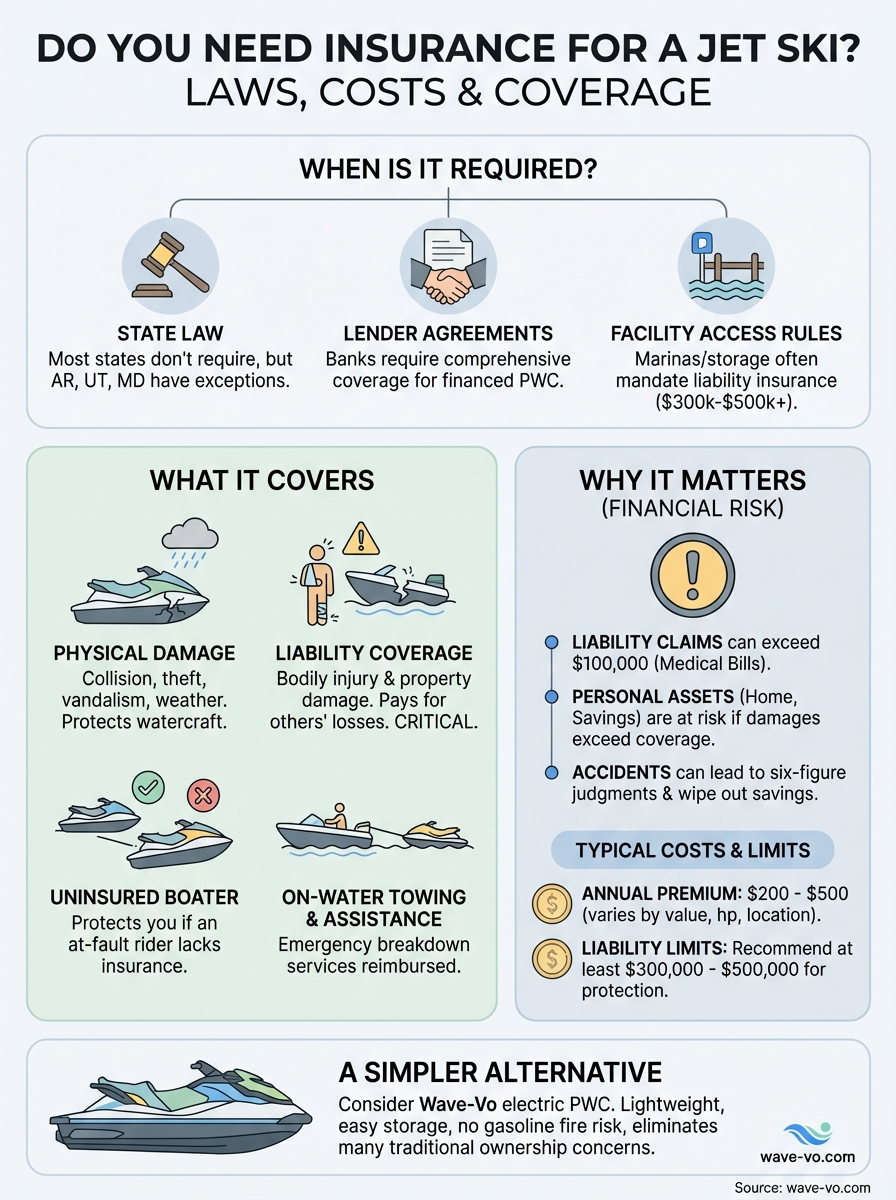
Understanding when do you need insurance for a jet ski depends on three factors: state law, lender agreements, and facility access rules. Each creates different obligations that directly impact whether you can legally operate your watercraft or access popular riding locations. Mandatory insurance requirements vary significantly across jurisdictions, and violating any of these rules can result in fines, confiscated equipment, or loss of riding privileges.
Legal requirements by state
Most states don't mandate insurance for personal watercraft through legislation, but specific exceptions exist in Arkansas, Utah, and parts of Maryland. Arkansas requires liability coverage for vessels with motors exceeding 50 horsepower, while Utah mandates coverage for any motorized watercraft operated on public waters. Maryland imposes insurance requirements in certain counties based on local ordinances rather than statewide law.
Even in states without mandatory insurance laws, courts hold operators fully liable for all damages and injuries caused during accidents.
Financing and facility mandates
Banks require comprehensive and collision coverage protecting their collateral throughout your loan term. Marina operators impose minimum liability limits ranging from $300,000 to $500,000 before granting dock access or launch privileges. Storage facilities frequently demand proof of insurance covering theft and fire damage as a condition of your rental agreement.
How to choose coverage and limits
Your coverage selection process starts with evaluating three factors: watercraft replacement cost, personal asset protection needs, and operating environment risks. Match your policy limits to these variables rather than choosing arbitrary numbers or accepting minimum recommendations from insurers. Base your decision on worst-case scenarios instead of optimistic assumptions about accident frequency or severity.
Assess your watercraft value
Calculate how much you'd need to replace your jet ski at current market prices, then add 10% for sales tax, registration fees, and dealer charges. If you financed the purchase, your lender dictates minimum physical damage coverage amounts. Consider agreed value policies over actual cash value to avoid depreciation disputes during claims processing. This assessment directly impacts your answer when evaluating do you need insurance for a jet ski based on your specific financial situation.
Calculate liability exposure
Review your total net worth, including home equity, retirement accounts, and savings, then purchase liability limits equal to or exceeding this amount. Courts can pursue these assets to satisfy judgments if your coverage falls short. Most experienced riders carry at least $500,000 in liability protection, with high-net-worth individuals opting for $1 million or more through umbrella policies.
Standard $300,000 liability limits provide insufficient protection for serious injury claims, which regularly exceed that threshold.
How much jet ski insurance costs
Your annual premium typically ranges from $200 to $500, though rates fluctuate based on watercraft value, coverage limits, and your operating history. Basic liability-only policies start around $150 per year, while comprehensive packages protecting newer or high-performance models can exceed $800 annually. Understanding these cost drivers helps you budget accurately when determining do you need insurance for a jet ski.
Factors that affect your premium
Insurers calculate rates using watercraft value, horsepower, operator age, and claims history as primary rating factors. Higher-value watercraft and more powerful engines increase premiums because they represent greater replacement costs and higher accident risks. Your location matters significantly, as states with higher accident rates or theft statistics command higher premiums than low-risk areas.
Typical premium ranges
Budget $200 to $300 annually for liability-only coverage on older or lower-value watercraft. Comprehensive and collision protection on models worth $8,000 to $15,000 typically costs $400 to $600 per year. High-performance watercraft exceeding $20,000 in value often require $700 to $1,000 in annual premiums depending on coverage limits and deductible selections.
Choosing a $1,000 deductible instead of $250 can reduce your annual premium by 20% to 30%.
What to do next
Now that you understand whether do you need insurance for a jet ski, take action before your next ride. Contact at least three insurers specializing in watercraft coverage to compare quotes and policy terms, then verify your state's specific requirements through your local Department of Motor Vehicles or marine law enforcement agency. Check with your marina or storage facility about their mandatory insurance minimums, and review your homeowner's or umbrella policy to identify any existing watercraft liability protections.
If you're frustrated by the ongoing costs and complications of traditional jet ski ownership, consider the Wave-Vo electric personal watercraft as an alternative that eliminates many insurance concerns. Wave-Vo's lightweight design means you can store it in your garage or vehicle rather than paying for marina dock fees, and the electric propulsion system removes fire risks associated with gasoline engines. Explore Wave-Vo's innovative electric watercraft that combines go-kart agility with the convenience of grab-and-go water recreation.