
Nothing kills a good day on the water faster than a botched landing. Whether you're sidling up to a busy marina or pulling into a narrow slip, solid boat docking techniques separate confident captains from the folks bouncing off pilings. The truth is, docking doesn't require years of experience, it requires understanding a few core maneuvers and practicing them until they're second nature.
Wind, current, boat size, and propulsion type all play a role in how you approach a dock. A heavy twin-engine cruiser handles very differently from a compact, agile craft like a Wave-Vo electric jet boat, where the tight 1.2-meter turning radius and instant electric throttle response make close-quarters maneuvering far more forgiving. But regardless of what you're piloting, the fundamentals stay the same: slow speeds, good angles, and a plan before you commit.
This guide breaks down five proven docking techniques that work across vessel types and skill levels. You'll learn how to read conditions, position your approach, and make adjustments on the fly, so every landing is smooth, controlled, and free of dock rash.
1. Wave-Vo precision approach and stop
The Wave-Vo precision approach and stop leverages the craft's electric motor for instant throttle response and a 1.2-meter turning radius for last-second corrections. This technique suits most standard dock situations: calm to moderate conditions with enough room to line up a clean angle before you commit to the final run.
What it is and when to use it
This technique uses a shallow 20 to 30-degree approach angle combined with a final reverse burst to stop cleanly alongside the dock. It works best when you have open water ahead and a face dock rather than a tight slip. The Wave-Vo's electric propulsion removes the engine lag that makes this move harder on gas-powered craft.
Step-by-step maneuver
Begin at idle speed, aimed at a 20 to 30-degree angle to the dock. At one boat length out, start cutting throttle. Once the hull runs parallel and sits 1 to 2 feet from the dock, apply a short reverse burst to stop forward movement. Step off at the bow and secure your bow line first, then the stern line.
Wind and current tweaks
Wind pushing you toward the dock calls for a shallower 15-degree angle and earlier throttle reduction. Wind pushing you away means you need a steeper 45-degree angle to compensate for drift before going parallel.
When in doubt, approach slower than you think you need to. Speed causes far more dock damage than any other single factor.
Line and fender setup
Set fenders at mid-hull height on your docking side before the approach. Have a bow line and stern line ready to deploy the moment you touch. On the Wave-Vo's compact 75kg hull, one mid-cleat spring line typically holds position after the initial tie-up.
Common mistakes and fixes
Most pilots come in too fast and too steep, forcing a sharp last-second correction. If you drift wide, resist accelerating; instead, apply a short reverse pulse to realign. Practicing this sequence in open water builds the muscle memory that makes these boat docking techniques feel natural over time.
2. Bow-into-wind controlled approach
The bow-into-wind approach turns wind from an obstacle into an advantage. By pointing your bow directly into the breeze, you gain better control and a longer reaction window during the final run to the dock.
What it is and when to use it
Use this technique when wind is blowing off the dock or at a strong angle that would push your stern around. Pointing the bow into the wind keeps the hull stable and reduces sideways drift as you slow.
Step-by-step maneuver
Approach at a 45-degree angle with the bow pointed into the wind. Reduce throttle early and let the breeze scrub your speed. At one boat length out, shift to neutral, let the wind bring you to a stop, then secure your bow line first.
The wind is free stopping power. Use it instead of fighting it.
Wind and current tweaks
A strong headwind means you can cut throttle earlier and drift in smoothly. A lighter wind requires a small forward throttle burst to maintain steerage and avoid crabbing sideways at the final moment.
Line and fender setup
Deploy fenders on the docking side before your approach. Keep your bow line in hand as you shift to neutral so you can step off and secure without scrambling.
Common mistakes and fixes
Most pilots commit too late to the wind angle and arrive sideways to the dock. Set your bow-into-wind heading at two boat lengths out rather than one, and you'll have enough time to correct any drift before these boat docking techniques can go wrong under pressure.
3. Spring line pivot to bring the stern in
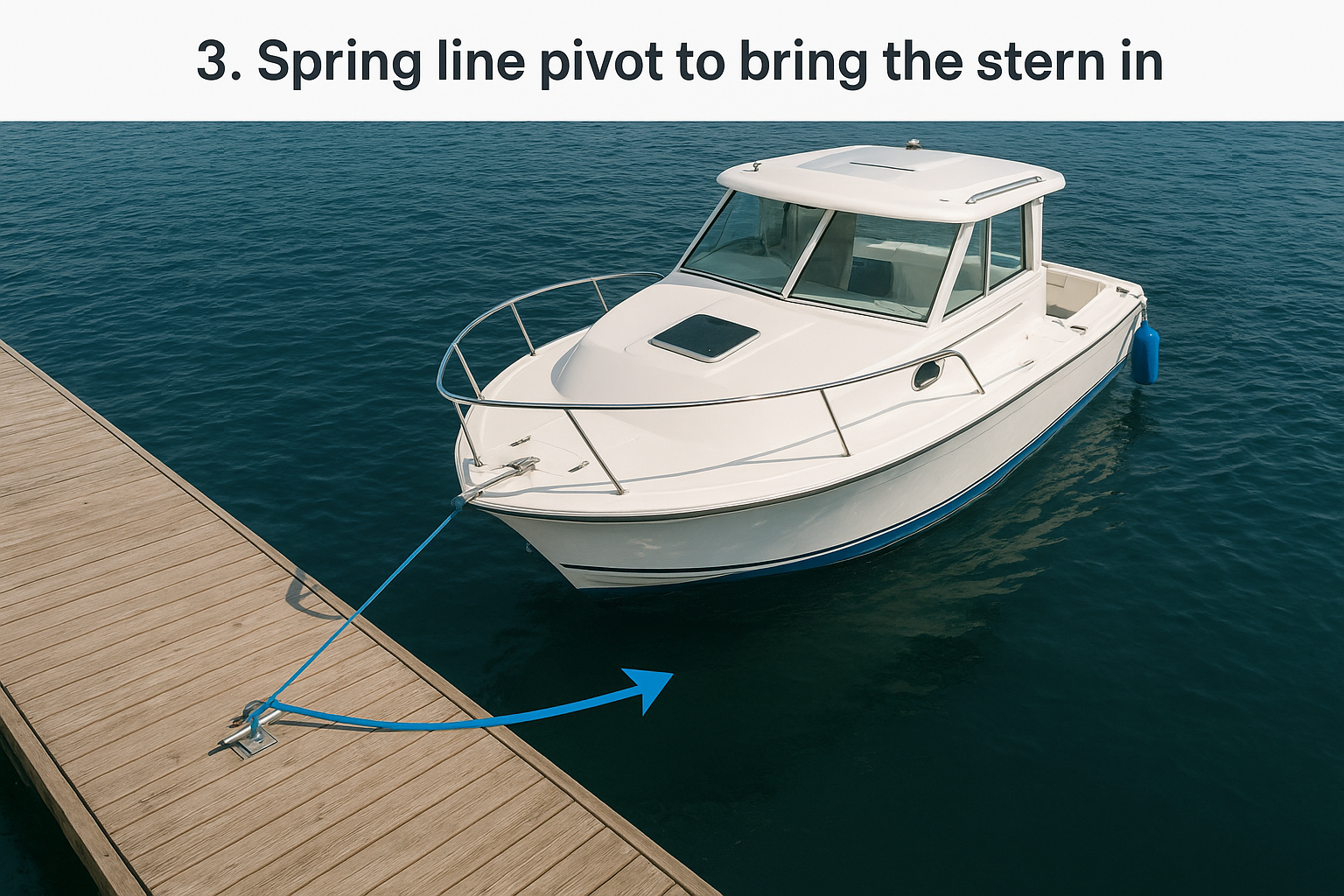
The spring line pivot uses mechanical leverage instead of raw throttle to swing your stern alongside the dock. It's one of the most reliable boat docking techniques for tight situations where a straight approach won't work.
What it is and when to use it
This maneuver uses a forward spring line clipped from your bow cleat to a mid-dock cleat to rotate the stern in. Use it when wind or current is pushing your stern away and direct approaches keep failing.
Step-by-step maneuver
Approach at a 30-degree angle and attach a line from your bow cleat to a dock cleat positioned near amidships. Apply gentle forward throttle while turning the wheel away from the dock. The stern swings in as the bow holds position. Shift to neutral and secure your stern line.
Once the spring line is set, let the boat do the pivoting. Short throttle pulses control the swing.
Wind and current tweaks
Wind pushing your stern off the dock requires more throttle pressure to overcome the drift. Current running with you calls for a shorter spring line to keep the pivot point tight.
Line and fender setup
Position fenders at the stern quarter before starting. Run your spring line from the bow cleat to a mid-dock cleat for the cleanest pivot arc possible.
Common mistakes and fixes
Most pilots apply too much throttle and drive the bow into the dock instead of swinging the stern in cleanly. Keep inputs short and gentle, and the pivot will happen on its own.
4. Reverse-in slip docking with short bursts
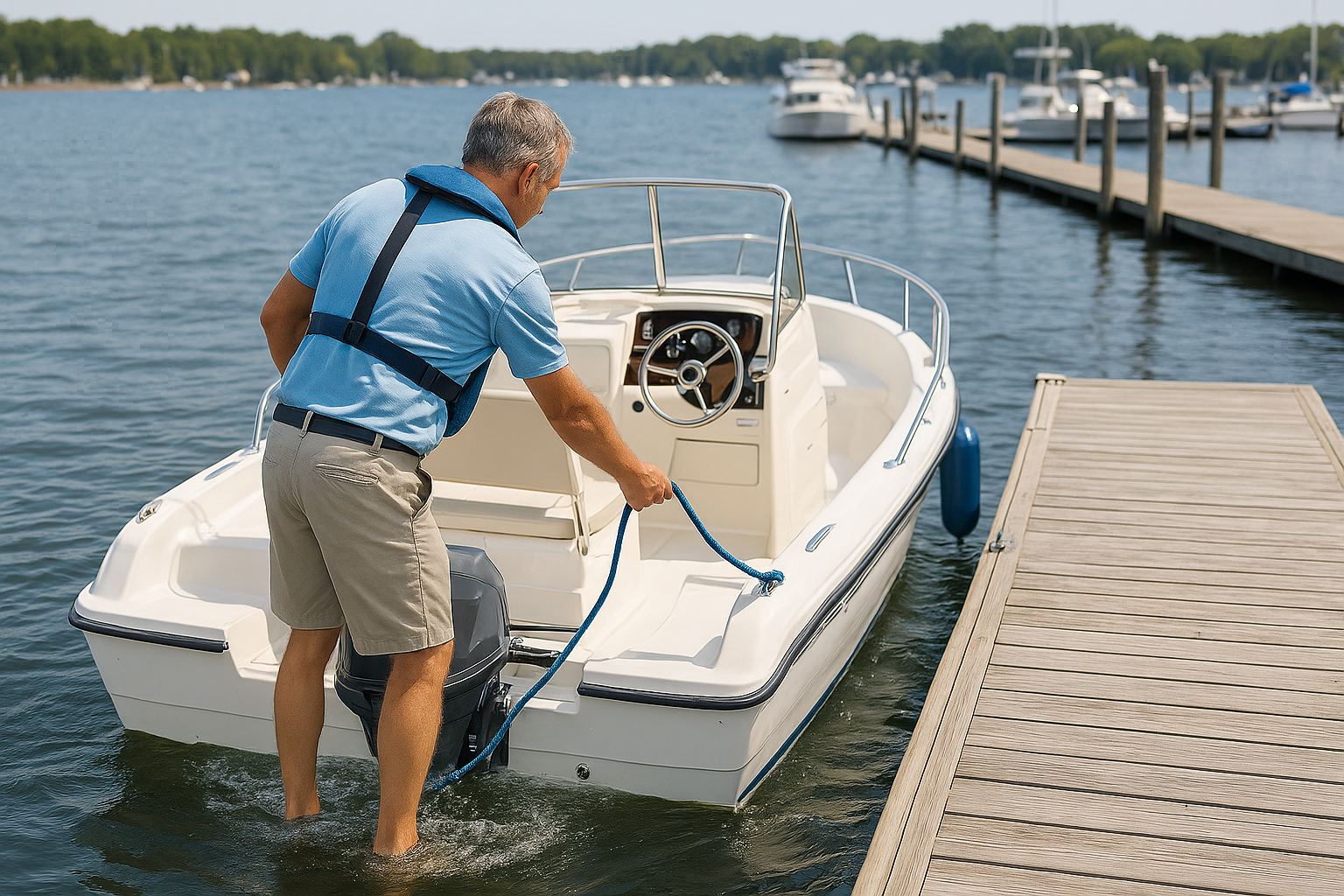
Reversing into a slip is one of the trickier boat docking techniques, but mastering it pays off because it puts your stern access right at the dock and makes the next departure far easier.
What it is and when to use it
This technique uses controlled reverse throttle pulses to back the stern into a slip while keeping directional control. Use it when you need to park bow-out for quick departure or when the dock layout requires stern access first.
Step-by-step maneuver
Line up directly in front of the slip entrance at idle speed. Shift into reverse and apply short throttle bursts to move the stern back without building momentum. Correct your angle with brief forward pulses on alternating sides as needed, then secure your stern lines the moment the hull reaches the dock cleats.
Short bursts beat sustained reverse power every time. Momentum is what causes slip entries to fall apart.
Wind and current tweaks
Wind pushing you sideways toward a slip wall requires earlier corrections on the downwind side. A following current means you should reduce reverse throttle since the water is already pushing you back.
Line and fender setup
Place fenders on both sides of the hull before entry. Keep stern lines pre-coiled and ready to toss the moment your stern reaches the dock.
Common mistakes and fixes
Most pilots build too much reverse speed and cannot stop before hitting the back wall. A short forward burst kills that momentum without pushing you sideways out of the slip.
5. Crosswind set-and-drift side tie
The crosswind set-and-drift side tie turns a perpendicular wind into a controlled positioning tool. This technique works by using natural forces rather than throttle to place your hull alongside the dock face.
What it is and when to use it
This maneuver uses the wind to drift your hull sideways onto the dock face. Use it when wind blows directly onto the dock and a powered approach would push you in too hard to control.
Step-by-step maneuver
Position your hull parallel to the dock at about 10 feet out. Cut throttle and let the crosswind push you sideways toward the dock. Secure your bow and stern lines the moment the hull makes contact with the dock face.
Wind and current tweaks
Stronger wind means you need more standoff distance to control your drift rate. A countering current requires a brief forward throttle burst to hold your parallel heading while the wind does the work.
Set your parallel position earlier than feels necessary. The wind closes that gap faster than most pilots expect.
Line and fender setup
Deploy fenders evenly along your docking side before cutting throttle. Keep bow and stern lines ready for a fast tie-up the moment the hull settles against the dock.
Common mistakes and fixes
Most pilots hold too much throttle trying to manage the drift and arrive at an angle instead. Cut power early and trust the hull to settle into parallel contact with the dock.
Quick Recap and Next Steps
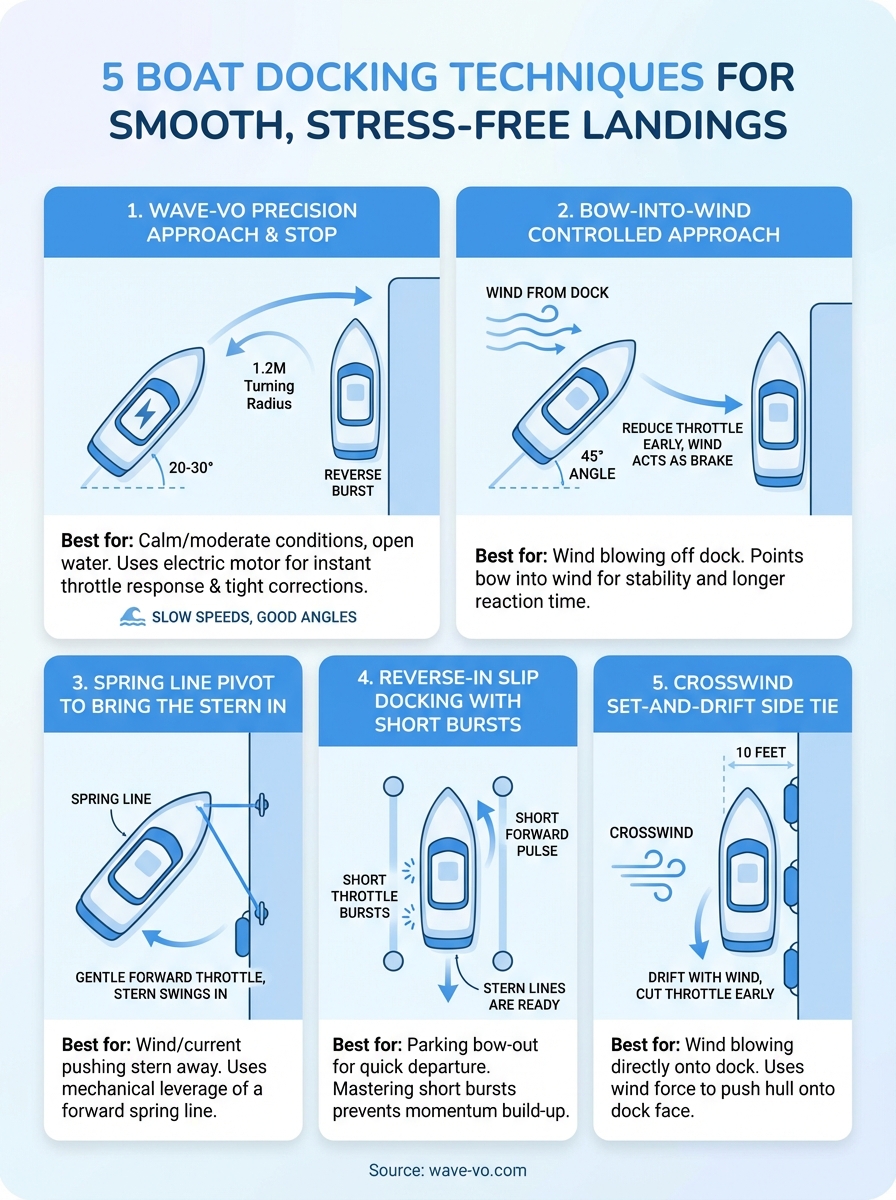
Each of these five boat docking techniques gives you a specific tool for a specific situation. The precision approach handles everyday calm-water landings. The bow-into-wind method turns breeze into a stopping advantage. The spring line pivot gives you leverage when direct approaches fail. Reverse-in slip docking sets you up for fast departures. The crosswind set-and-drift side tie lets natural forces do the positioning work for you.
Practicing one technique at a time in low-traffic water builds the real muscle memory that holds up under pressure. Start with the precision approach until it feels automatic, then add each method to your rotation.
If you want a craft that makes these maneuvers easier from the start, the tight turning radius and instant electric throttle of a Wave-Vo puts more control in your hands on every landing. Explore the Wave-Vo electric jet boat and see how it changes your time on the water.